Within a seventeenth-century villa, chef Silvia Baracchi leads Il Falconiere — a Michelin-starred restaurant and Relais & Châteaux hotel where falconry, local produce, and winemaking define the rhythm of rural Tuscany
Silvia Baracchi tells the story of Il Falconiere
“The first time you see a falcon, you either fall in love or you get scared — you can’t stay indifferent.” Silvia Baracchi has dedicated her work to the falcon and falconry. Il Falconiere, a one-Michelin-star hotel and restaurant near Cortona, is where she serves as Chef. “The falconer and the falcon live in symbiosis. The falconer is the center of the falcon’s world — he recognizes him among a thousand people.” Falconry, the noble art of training and flying birds of prey for hunting, is an ancient practice recognized by UNESCO as an intangible cultural heritage in 18 countries. Around 1260, Emperor Frederick II of Swabia — considered its father in Italy — dedicated a treatise to it, De arte venandi cum avibus.
Falconry is not just a thing of the past. It remains a living reflection on the relationship between man and nature, between human and animal. The falcon has never been domesticated; the bond must be one of trust. It becomes an extension of the human being. “I’ve always had falcons. The last one, last year, flew away,” says Silvia Baracchi. “During the day he’d stay on a perch in the lawn in front of the reception. In the afternoon, we’d let him fly. My first falcon was a kestrel named Pico. Then I had a peregrine named Abibi. Later, several Harris hawks — they’re quite calm. Since we have guests here, falcons that are too nervous or wild wouldn’t be suitable. I’ve always kept one at a time — you can’t fly them together, they hunt each other. As often happens in nature, the bigger one hunts the smaller. When you release the falcon and start walking, he follows you. Even if you don’t see him, he’s there, watching you. You call him — and he comes.”
Falcon Hunting — the Peregrine Falcon can reach 300 km/h
Falcons eat raw meat — pigeon or dove. “If they need to keep slim, we give them rabbit,” she explains. Hunting with falcons depends on their weight: “A falcon works well only when kept at the right weight. If they’re too fat, they’re not hungry and lose their hunting instinct. I used to weigh mine on a scale. My Harris hawk would get a small piece of dove each day. If they’re underweight, they’re nervous because they’re hungry. During the hunt, there’s usually also a dog — it flushes out the prey, makes it fly, and the falcon catches it. Sometimes the falcon kills the prey on impact, stunning it.” The peregrine falcon, she adds, can dive at speeds up to 300 km/h. “When the prey is caught, you have to retrieve it, and then you give the falcon a small piece as a reward. I’ll get a new falcon soon — usually in spring, from a breeder. You can’t take them from the wild — they’re protected animals. I’ll get a falcon from Eros.”

Il Falconiere — a Seventeenth-Century Villa in Cortona
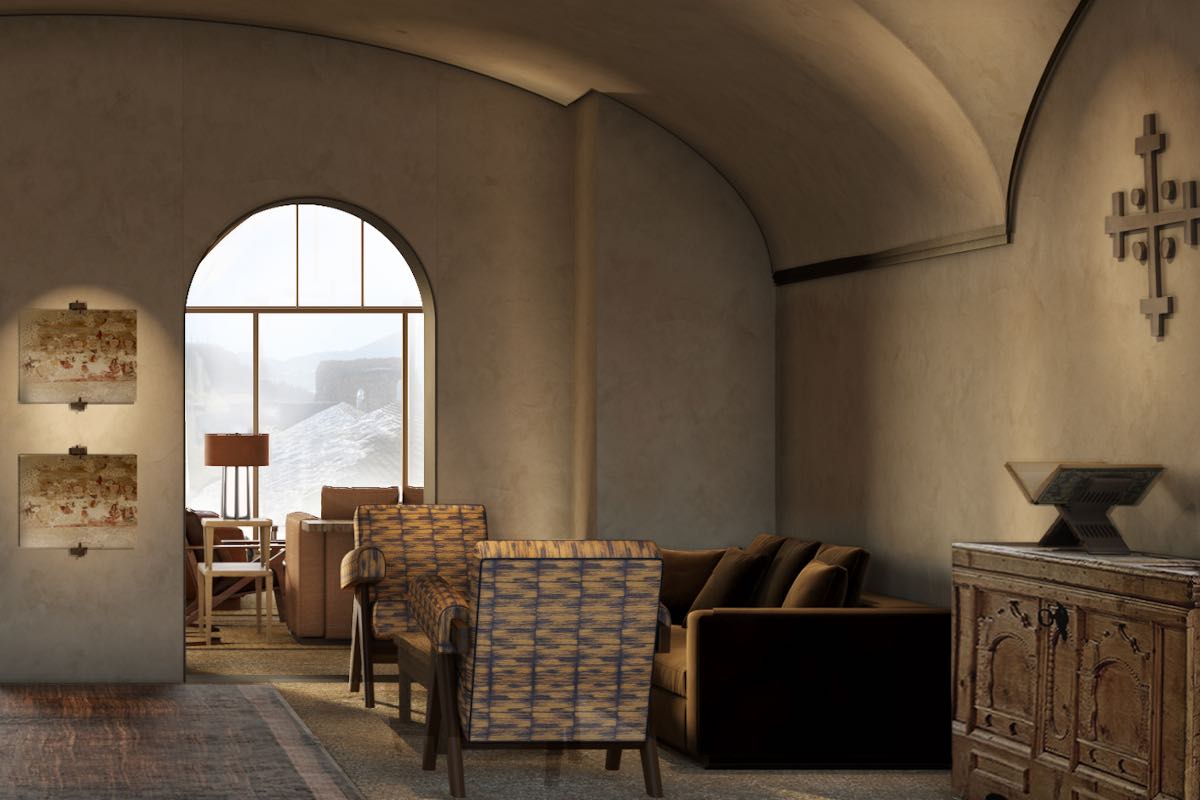
Silvia Baracchi belongs to this place. She speaks under the shade of horse-chestnut trees in front of the villa, which presides over 12 hectares of land. Always present, she observes, directs, and works with her own hands. With a Tuscan temperament — direct yet courteous — she treats her staff with warmth but also firmness when needed. The villa once belonged to Antonio Guadagnoli, a poet: “It’s said that when he was offered the post of gonfaloniere in Arezzo, he replied, ‘I would never leave my little villa in San Martino for the robes of the gonfaloniere.’” He lived here until the end of his days.

The Old Lemon House — Now the Glass Heart of Il Falconiere
This corner of Tuscany, near the Umbrian border, feels like a painting. The road to Il Falconiere follows a small stream, and after crossing a bridge, winding paths bordered by brick walls divide the vineyards and olive groves. At the top of a hill, a gate marks the arrival at the villa. Some of the hotel rooms are here, others in the farmhouse and in the nearby hamlet that once held the stables and the farmer’s house. Greenery is constant — English-style gardens, flowered paths, a small church, and a marble terrace framing a blue pool. The old lemon house is now a winter garden of glass, the heart of the property and one of the restaurant’s entrances.

The Restaurant — Silvia Baracchi’s Cuisine and Tuscan Ingredients
The restaurant occupies the ground floor of the old lemon house, now a luminous glass hall where interior and landscape are in dialogue. In the morning, sunlight reflects on the colorful ceramics used for breakfast. In the evening, guests arrive for Silvia Baracchi’s cuisine. “I use everything that grows around me. There’s always something from the land, every season. I rely on local suppliers who set aside their best products for me — well-aged Chianina beef, the fattest pigeons, fresh greens from a nearby farmer. In winter, I get black kale. I always work with seasonal vegetables — zucchini, tomatoes, squash blossoms, peppers, eggplants. Elderflower, when available, becomes a sauce for pork. I’m especially fond of autumn vegetables — cabbages, in particular. There are so many ways to use them in the kitchen.”


The Michelin Star for Il Falconiere arrived in 2022
“At the beginning, every restaurateur dreams of a star. When we opened in 1989 — only as a restaurant then — I thought I was ready for it. I wasn’t. After some years, I wondered why the star hadn’t come despite all the care and dedication. Then we got three red forks, and I thought they were starting to notice me. I kept improving — not for the star, but out of a natural desire to evolve. When the star finally arrived, in 2002, I wasn’t expecting it anymore.”
Her signature dish? “Probably pigeon — paired with prunes or shallots depending on the season. I have a palate that loves strong, contrasting flavors, and I bring that into my cooking. I usually change the menu completely around September, when summer gives way to autumn. Mushrooms appear, it’s hunting season, time for cabbages and pumpkin. When September ends, everything changes — the temperature, the sensitivity, even the palate.”
“I compost and try not to waste anything.” There are also hens — “We even had a rooster named Rocco. Unfortunately, someone closed the coop before all the chickens were in, and a fox ate seven hens and the rooster. I’ve just bought a new one, a Silkie, with black skin and silky plumage that feels like fur.”

Wine Production and the Legacy of Riccardo Baracchi
Silvia’s son, Benedetto, manages the winery. “When my husband Riccardo was alive, we were three — a real team. We argued, of course — I liked white, he liked black. But confrontation helps you improve, clarify your goals. That’s something I miss. We shared a life of passions. When we met, he brought me here, to his roots — his grandmother’s house. He loved nature, hunting, the outdoors. He couldn’t sit in front of a computer. He died last year during a hunting trip in Macedonia. He had heart problems, but he lived fully. He loved the vineyard, the garden — if he saw a drooping leaf, he’d prune it. He lived in symbiosis with nature.”


The Baracchi Wines
In addition to the villa’s 12 hectares, the estate includes 32 hectares of vineyards, producing sixteen labels. “My husband was a visionary — he’d wake up in the morning and decide to make a new wine. Each vintage has its own personality. We have Trebbiano and Sangiovese, native varieties, and also Syrah, Merlot, Cabernet Franc, and Cabernet Sauvignon. Many are single-varietal wines: 100% Merlot, 100% Syrah. Others are blends. We also make a metodo classico sparkling wine, and an orange-style Trebbiano fermented with the skins like a red. The vineyards are spread between Montepulciano and Lake Trasimeno — in Pietraia, where La Braccesca is, and in Montanare, on a hillside by a stream where we grow Pinot Noir. The area, called Merloncezzo, is rich in good things.”
Cortona and the Tourism Boom After Under the Tuscan Sun
After the publication of Frances Mayes’ Under the Tuscan Sun, Cortona saw a surge in international tourism. “The author often comes to this area — we’re friends. I’ve visited her in Raleigh, North Carolina, for Thanksgiving. She lived in a wooden house about 100–150 years old — as old as you can get in America! Now she’s moved to another home I haven’t yet seen.”
A few kilometers from Il Falconiere, perched above, lies Cortona, reachable even by e-bike provided by the hotel. The town still shelters behind its ancient Etruscan walls from the 4th century B.C. Inside, life pulses — tourists wander enchanted by the beauty, climbing and descending stone lanes, photographing, sitting joyfully at taverns serving pici with duck ragù and local red wine. They explore Cortona’s long history, from prehistory to late antiquity, at the MAEC – Museum of the Etruscan Academy of Cortona, founded in 1727, located in Palazzo Casali, which hosted the 2022 exhibition Signorelli 500, celebrating 500 years since the painter’s death — 15,000 visitors in just two months.


An Ambassador of Tuscan Cuisine
“I feel like an ambassador of Tuscan cuisine in the world. Soon I’ll leave for India, near Calcutta — I’m already making my shopping list. Some ingredients I’ll bring from here, others I’ll find there. This year I’ve been to Germany, to Denver in Colorado, last December to the Maldives, and before that to the Italian Embassy in Washington, where I cooked for the ambassador. I’ve also been to Accra, Ghana, to showcase Italian cuisine, and several times to China, where local chefs showed me their authentic spots. I’ve tasted the real local food, the kind tourists never try.”
Il Falconiere stays open until mid-November. “Then we close. We use the winter months for renovations and improvements. A historic home like this — from around 1650 — always needs care.”
Il Falconiere – A Relais & Châteaux Member
“I joined the Relais & Châteaux association in 1997. At the time, every hotel was family-run. Today, some are managed by large companies. You can’t be a member if you don’t have a restaurant. Back then, we spoke of the 5 Cs that defined Relais & Châteaux: Charme, Cuisine, Calme, Caractère, and Courtesy.”