Once a Byzantine stronghold and later a Renaissance villa, Castelfalfi is now a Tuscan hilltop retreat where centuries of history meet wine, olive oil, contemporary cuisine and holistic wellness
A prehistoric whale in Tuscany: how Castelfalfi’s rolling hills were once a seabed
The oldest inhabitant of Castelfalfi – long before it was called that – was a whale.
In the 1970s, the remains of the cetacean were discovered inside a large pheasantry. After being cleaned, they were moved to the Municipal Museum of Montaione. The whale is estimated to be around eight million years old.
Although the head was never found, part of the rib cage, with numerous ribs and vertebrae, has been preserved. The absence of the skull makes it difficult to determine the exact species, which might be Balaena montalionis (the “Whale of Montaione”), similar to one found in the late nineteenth century at Casina Ciulli, now kept at the University of Pisa Museum at the Certosa di Calci.
As Rino Salvestrini – one of the foremost scholars of this part of Tuscany and author of Storia di Castelfalfi – notes, the area was once submerged by the sea, and traces of many marine animals have been found on the hills around Castelfalfi.
Castello di Castelfalfi: a Tuscan hilltop castle reborn as landmark home of La Rocca fine dining
Castelfalfi lies in the municipality of Montaione, at the meeting point of three valleys formed by tributaries of the Arno. To the north-west is Volterra; to the south-east, following the Era valley, you reach the Arno plain and the city of Lucca.
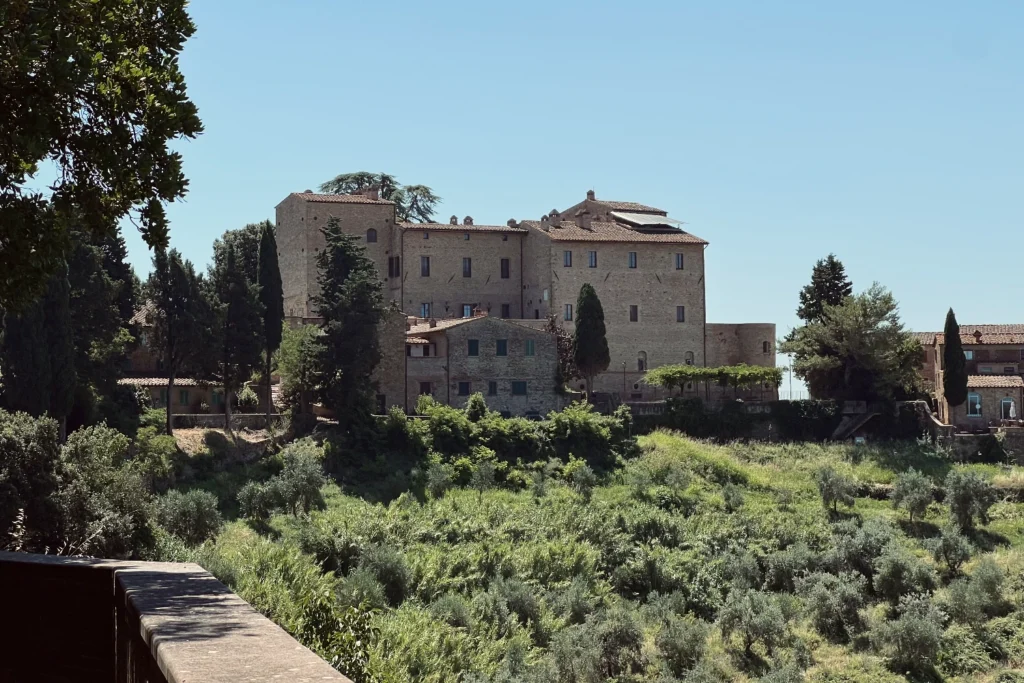
Perched on a rocky spur overlooking the valley, Castello di Castelfalfi continues to defy time with its imposing walls, bearing witness to over a thousand years of history and layered cultures. Set in the rolling Tuscan landscape – which seems almost drawn by an inspired demiurge rather than born of the primordial chaos of the Big Bang – this place has been contested and cultivated since Etruscan times. From east to west, people have found here an ideal place to settle and thrive.
Inside the castle there was once a painting of Costanza de’ Medici, wife of Giovanni Francesco di Francesco Gaetani. It remained there until the last century, when it was sold to an antiques dealer, restored and later moved to a private collection in the United States. The painting is attributed to the school of Sandro Botticelli, and some believe it may be by the master himself. At the entrance to the castle, a replica of the portrait is on display.
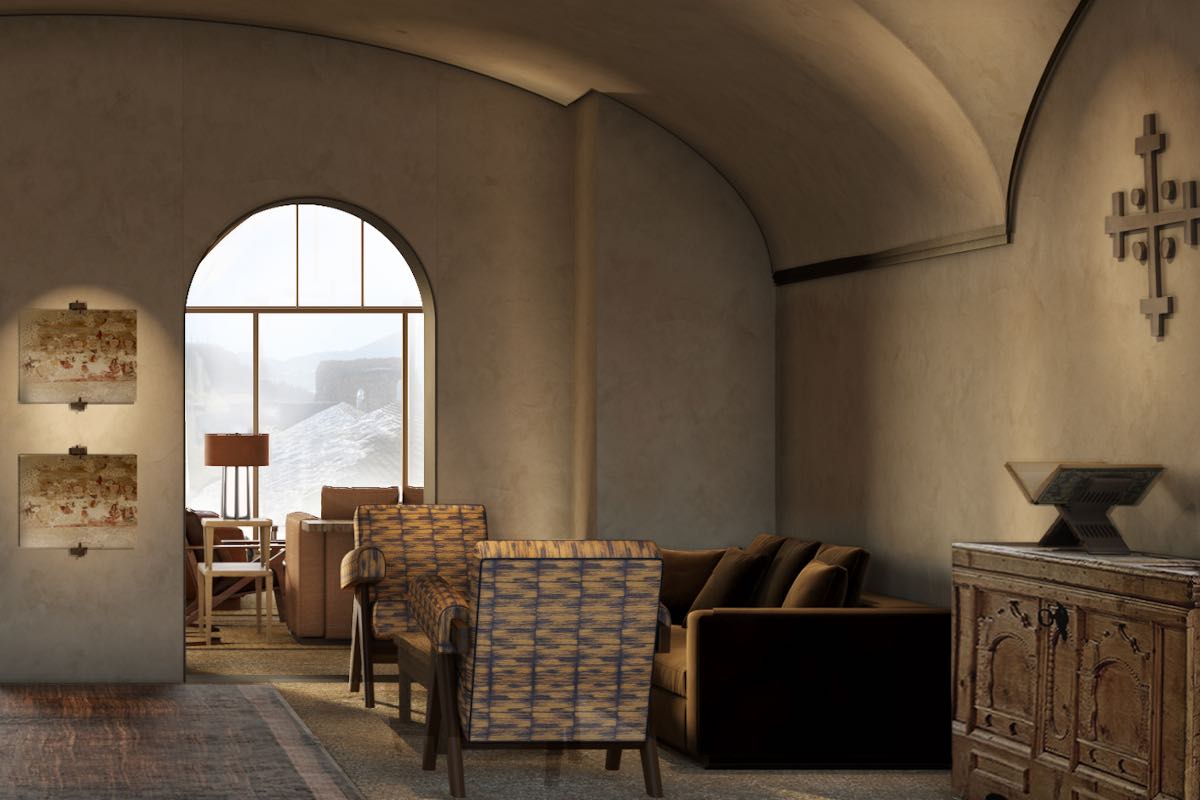
A stone plaque nearby bears the date 1485, the year in which Giovanni Francesco di Francesco Gaetani transformed the fortress into the villa that still defines its present-day form. Today, this entrance leads to La Rocca, the fine-dining restaurant inaugurated in 2024 and helmed by Executive Chef Davide De Simone – the latest gastronomic chapter of the Castelfalfi estate.
Sicilian by birth and cosmopolitan by experience, De Simone pays tribute to the cultural layers of Castelfalfi at La Rocca, drawing on his roots and blending culinary geographies in meat and fish dishes – the sea, after all, is just beyond the horizon.
Love, legend and inheritance in Castelfalfi: the Gaetani and Biondi families’ Tuscan tale
The stories that once animated the castle halls, the alleys of the hamlet and the paths through the valley have often become intertwined with legend. Among them, one tale concerns two families who alternated in the ownership of Castelfalfi.
The noble Gaetani family from Pisa had purchased part of the Castelfalfi farm, as evidenced by the stone and marble coats of arms still visible today. Among its members was a young woman. One day she met a blacksmith named Biondi di Lano, who worked at Castelfalfi. Struck by his strong figure and the way he forged iron, she fell in love with him – and he with her.
One day, the young woman had a horse saddled to ride to nearby Montaione to do some shopping. On the way, a wild boar suddenly burst out of the scrub, spooking the horse, which reared and threw her. She hit her head on a stone and died. To honour the love that had bound her to the blacksmith, the Gaetani family donated their property in the Castelfalfi farm to Biondi.
This, the story goes, is how the Biondi family came to own the farm, which they then expanded and maintained for 500 years. Although the tale remains a legend, some believe the young woman may have been a descendant of Costanza de’ Medici – the very one portrayed in the painting – wife of Giovanni di Francesco Gaetani.

From Byzantine stronghold to Renaissance villa: how Castelfalfi evolved on the Tuscan frontier
Castelfalfi began life as a Byzantine castle, conceived to coordinate the defence against the Lombards in the region north of Volterra. Between 550 and 600 AD, it was known by the Byzantine name Kastron Eurias.
The fortifications proved insufficient to halt the Lombard advance. Under King Agilulf and later King Alboin, the Lombards conquered Volterra and the Byzantine castles of the Valdera, turning them into strongholds of their domain. Castelfalfi was restructured by the new rulers and renamed Castel Faolfi, in honour of the Lombard leader Faolfo. It took on the typical features of Lombard fortifications, of which little remains today: the castle was altered during the High Middle Ages, after the year 1000, when it was turned into a cassero – the most heavily fortified part of the complex, initially housing the local “Lords” and later the soldiers in the service of the Commune.
Around the castle, a hamlet grew up, with houses, craft workshops and a church. Lacking high defensive walls, the village relied on the natural protection of the terrain, and in times of danger – such as military raids – inhabitants sought refuge within the castle.
In the sixteenth century, the castle was transformed yet again, taking on the appearance of a Renaissance villa, much as we see it today. From the 1500s, the Biondi family resided there, exercising control over the community of Castelfalfi until 1774, when – as part of Grand Duke Leopold of Tuscany’s reforms – Castelfalfi was incorporated into the municipality of Montaione.
From sharecroppers to empty farmhouses: the end of mezzadria in rural Castelfalfi and Tuscany
For centuries, the farms on the estate were divided into poderi, with houses scattered across the countryside and inhabited by sharecroppers. This agricultural structure, unchanged for generations, disappeared almost abruptly between 1955 and 1970.
The sharecroppers moved down into the valleys, drawn by new job opportunities in the flourishing post-war shoe, furniture and manufacturing industries. The now-empty farmhouses began to deteriorate: the barns, with their fragile roofs, were the first to collapse. The main dwellings also started to show the effects of abandonment. Older stone buildings proved more resilient than those from the nineteenth century, which were built with less durable materials.

Developers, big ideas and setbacks: late-20th-century projects that reshaped the Castelfalfi estate
Major changes in Castelfalfi unfolded between 1965 and 1990. After centuries of Biondi ownership, the estate passed to the Benelli family of Prato, known for their activities in the textile and dye industries. Yet the pull of urban life and the job opportunities offered by factories along the Valdarno contributed to the depopulation of the hamlet.
Around 1980, the property was purchased by a group of Milanese entrepreneurs led by manager Umberto Sportelli, with an ambitious development plan drawn up by architect Adorno. The idea was to combine agriculture and tourism in a large-scale project. After complex negotiations with the Tuscany Region, the plan began in 1983.
The economic crisis slowed progress, but the company was already employing around 120 workers, involved in restoring buildings, constructing sports facilities and expanding agricultural activities.
In agreement with the municipality, the project aimed at controlled tourism development, preserving the integrity of the agricultural estate while expanding crops and livestock. However, during its implementation the management was undermined by the financial difficulties of several national banks. After multiple changes of ownership, the estate ended up under court supervision, which prepared a negotiated sale. Numerous Italian and foreign companies expressed interest; among the names circulating were prominent figures such as Berlusconi, Agnelli and Casiraghi.
In 1982, Milanese entrepreneur Virginio Battanta purchased from the Florence court the companies that owned the medieval hamlet and 1,320 hectares of agricultural land on the Castelfalfi estate, including 36 farmhouses and the golf course. This marked the start of a gradual redevelopment of the land and buildings, a process carried out in several stages from 2011 to the present day.

Castelfalfi today: a luxury Tuscan resort reborn with a €650-million restoration, golf and a medieval borgo
In mid-2021, the resort was sold by German tourism group TUI – which had owned it since 2006 – to Sri Prakash Lohia, Indonesian industrialist and patron of Indian origin, founder and chairman of the diversified petrochemical and textile group Indorama Corporation.
1 April 2022 marked the beginning of a new phase for Castelfalfi, with a vast restoration programme – representing an investment of €650 million – affecting the entire area. The estate now offers a variety of accommodation solutions distributed between the main building, the former tobacco-drying house and the surrounding farmhouses.
The hamlet, dotted with shops, also includes a Medici tower, a small church for weddings, a 27-hole golf course (18-hole Mountain Course and 9-hole Lake Course) and a working agricultural estate with 163 hectares of vineyards and olive groves.
The estate extends over 1,100 hectares, about 350 of which are covered by woodland and oak forests interspersed with ponds. Almost the entire area falls within the protected natural reserve of the Carfalo stream. This unspoilt environment is home to rich fauna, including the rare spectacled salamander and many other species.
The hills of Castelfalfi have been inhabited since Etruscan times, thanks to their position above the marshy, unhealthy valleys formed by the great rivers such as the Arno and its tributaries. These wooded highlands were ideal for growing cereals, vines and olive trees – staples of ancient agriculture.

Organic vineyards, olive groves and honey: inside Castelfalfi’s Tuscan farm, wines and extra-virgin olive oil
The agricultural company comprises 25 hectares of vineyards and 10,000 olive trees, with fully organic production. Among the techniques used to restore organic matter in the soil is green manure: growing plants, often legumes, and then ploughing them under while still green to improve soil fertility. As they decompose, these plants enrich the earth with nutrients – especially nitrogen – and improve soil structure, increasing its water-retention capacity and reducing erosion.
Agricultural management is entrusted to agronomist Diego Mugnaini and oenologist Emiliano Falsini.
The olive varieties include Frantoio, Moraiolo, Leccino and Pendolino, used to produce a cold-pressed IGP extra-virgin olive oil, extracted within six hours of harvesting. The vineyards include Sangiovese, Merlot, Cabernet, Vermentino and Syrah, yielding eight wine labels and a vin santo.
Among these stands Castelfalfi IGT, a blend of Cabernet Sauvignon, Merlot and Petit Verdot, aged in French oak barriques and cocciopesto amphorae. The estate also produces beer, vermouth, gin and honey, with 40 beehives managed according to the natural rhythms of the bees.

Sustainability at Castelfalfi: water-saving, renewable energy and low-impact golf in the Tuscan countryside
The property has carried out structural works to ensure water and energy self-sufficiency. Artificial basins have been created to collect rainwater, along with plants for recycling and filtering wastewater, a wood-biomass generator, a biofilter to recover food waste and a photovoltaic system for solar energy production.
Cultivations follow organic practices, with no pesticides or chemical products and the use of natural fertilisers. Even the golf course uses a grass variety with low water consumption.
Lighting in the hamlet is predominantly natural, to preserve the day–night cycle and support the well-being of guests, wildlife and plants. Artificial lighting is provided by low-emission LED fixtures. Single-use plastics have been completely eliminated and renovation works have been carried out according to bio-building principles.
The company uses an Environmental Management System (EMS) to monitor and improve its environmental performance. The estate’s restaurants adopt a short supply chain, favouring local, sustainable products.


Dining at Castelfalfi: from L’Olivina’s Tuscan flavours to La Rocca fine dining with sunset views
Castelfalfi’s restaurants are overseen by Executive Chef Davide De Simone. Among them is L’Olivina, the hotel’s signature restaurant designed by artist and designer Henry Chebaane. Conceived as a landscape-like pathway, it invites guests to a sensorial exploration of the flavours, scents and colours of Tuscany.
The name honours the generous land, rich in vines and olive groves, and recalls the translucent green stone known to the Etruscans as the “gem of the sun”.
Walking along the main street of the hamlet, you reach La Rocca, the fine-dining restaurant inaugurated in June 2024, in the highest point of Castelfalfi. Here, as the sun sinks behind the hills, an intense red light and the white noise of the wind transport guests into a sensorial dimension suspended in time. Inside, reclaimed wood, stone and terracotta harmonise to reflect the natural tones of the countryside.
Davide De Simone’s culinary concept, “Il Mio Paese” (“My Homeland”), expresses an idea that transcends time and borders: his Sicilian roots intertwine with a cosmopolitan outlook in seasonal menus that showcase the freshness of local ingredients, inspired by ancient Tuscan traditions and paired with a carefully curated wine selection.

RAKxa spa at Castelfalfi: Thai-inspired holistic wellness in the heart of the Tuscan hills
The new ownership’s restyling programme has also transformed the spa, introducing new spaces and treatments by RAKxa, the Thai wellness concept.
RAKxa – from the Thai verb “รักษา” (rák-sǎa), meaning “to care for” or “to heal” – brings a holistic, healing approach to the Tuscan hills. The spa features two pools: an indoor one surrounded by mosaic-clad columns and an outdoor one with views over the countryside.
There are seven treatment rooms, including a couple’s suite, two saunas, a steam bath and a relaxation area. The new palette is inspired by the surrounding landscape, with natural, muted shades ranging from gold to beige.
An outdoor gazebo allows for open-air treatments in spring and summer, for a full immersion in nature.