At Corso Venezia 11, the Lungarno Collection has converted a monumental Baroque complex into a hotel, cultural hub, and gastronomic destination at the center of the Fashion District
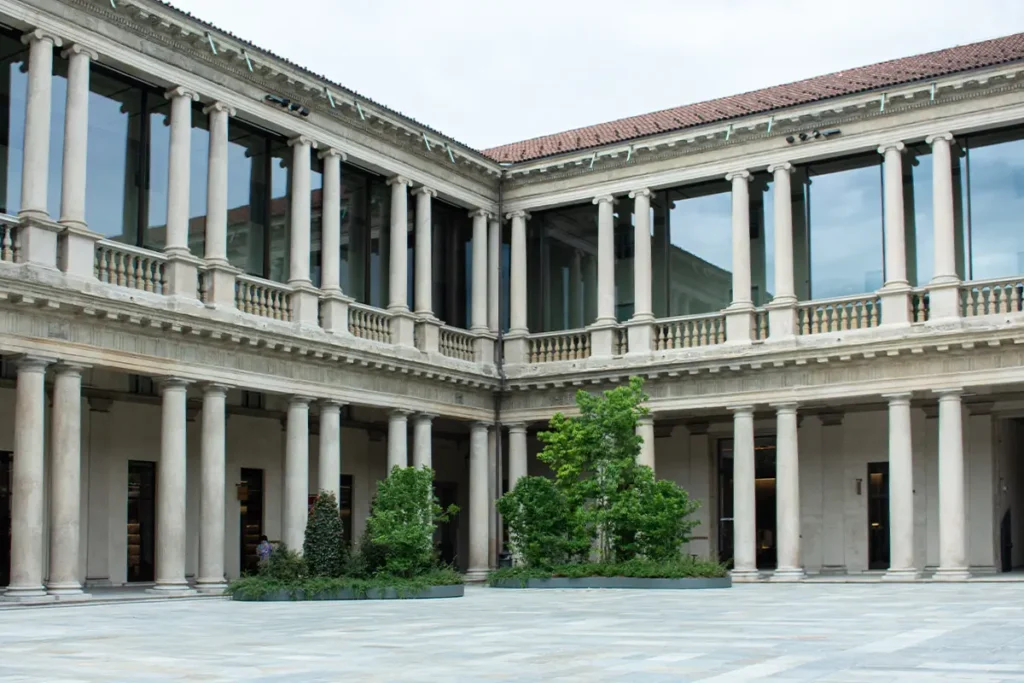
What was once the archiepiscopal seminary in the heart of Milan—an austere stronghold dedicated to religious education located between Corso Venezia, Via Bagutta, and Via Sant’Andrea—has transformed into Portrait Milano, a luxury hotel by the Lungarno Collection, the hospitality group of the Ferragamo family. The structure’s monumental proportions include a double-columned cloister framing all four sides of a vast stone-paved square, now restored and opened to the public.
The seminary’s Baroque portal and the Borromeo family legacy at Corso Venezia 11
The entrance through the rusticated Baroque portal at Corso Venezia 11 immediately recalls the cultural and spiritual origins of this citadel, conceived during a period of intense artistic and architectural fervor in post-Tridentine Milan. The Borromeo family motto Humilitas, inscribed above the archway in Gothic script, anchors the building’s religious heritage. First envisioned in the late sixteenth century under the influence of St. Charles Borromeo, the seminary evolved through various ecclesiastical and civic functions over the centuries before falling into disuse in the late twentieth century. Until the 1990s, part of the structure served as Mario Bellini’s design studio, a final echo of creative life before its transformation began.
Michele De Lucchi’s cloister redesign: boutiques, cafés, and public life in the porticoes
The enormous cloister, revived by Michele De Lucchi and AMDL Circle, has been reimagined as a contemporary urban square that blends heritage and modernity. Fashion and design boutiques now inhabit the porticoes, including Antonia, a 750-square-meter fashion destination designed by Vincenzo De Cotiis, and SO-LE Studio, the first flagship of Maria Sole Ferragamo’s jewelry brand dedicated to transforming discarded materials into wearable sculpture. Cafés and restaurants animate the square throughout the day, among them 10_11, conceived by Michele Bönan as a fluid sequence of bar, garden, and restaurant. Its striped textiles, rattan seating, lanterns, and verdant walled garden echo both the sophistication of its interiors and the serenity of the historic cloister.
Beefbar Milano by Humbert & Poyet: the former seminary chapel as a cosmopolitan restaurant
Beefbar Milano, the first Italian outpost of Riccardo Giraudi’s dining concept, occupies the former chapel of the seminary. Its interiors, designed by Humbert & Poyet, create a dialogue between sacred architecture and cosmopolitan dining culture, drawing inspiration from mid-century Milanese masters such as Luigi Caccia Dominioni and Osvaldo Borsani. Sculptural lighting, sumptuous materials, and a refined palette set the stage for a menu defined by premium meats, Wagyu selections, contemporary tartares, and globally inspired comfort dishes.
Rumore, the cocktail bar and live music venue inside Portrait Milano’s cloister
Rumore is an American-style bar whose name pays whimsical homage to Raffaella Carrà’s iconic song. It combines crafted mixology with a dynamic musical program, shifting from aperitivo to late-night performance. Its classic and contemporary beverages and curated champagne list have quickly made it one of Milan’s most consistent nightlife addresses.
Michele Bönan’s interior design at Portrait Milano: copper, marble, and mid-century Milanese references
The interior architecture of the hotel—extending from public spaces to suites and loggias—was entrusted to Florentine architect Michele Bönan, a long-standing collaborator of the Ferragamo family. His approach revives the spirit of the original complex while infusing it with a serene, luminous modernity. The vaulted reception hall introduces this balance with a copper counter illuminated as if suspended within the stone structure. A long communal table, reminiscent of the fratine of Michelucci and Tempestini, anchors the space with books, vintage objects, ceramics, and bronzes. A 1950s plaster relief by Denis Morog stretches across an entire wall. Oversized sofas, écru seating, and geometrically patterned carpets in brown, sand, black, and turquoise emphasize the grandeur of the room’s proportions.
Throughout the hotel, vintage pieces from the 1950s to the 1970s coexist with bespoke furnishings created by Bönan. The projecting-weave boiseries discreetly reference the understated luxury of Portaluppi and Tomaso Buzzi, echoing the spirit of Villa Necchi Campiglio while embracing a more linear and contemporary sensibility.
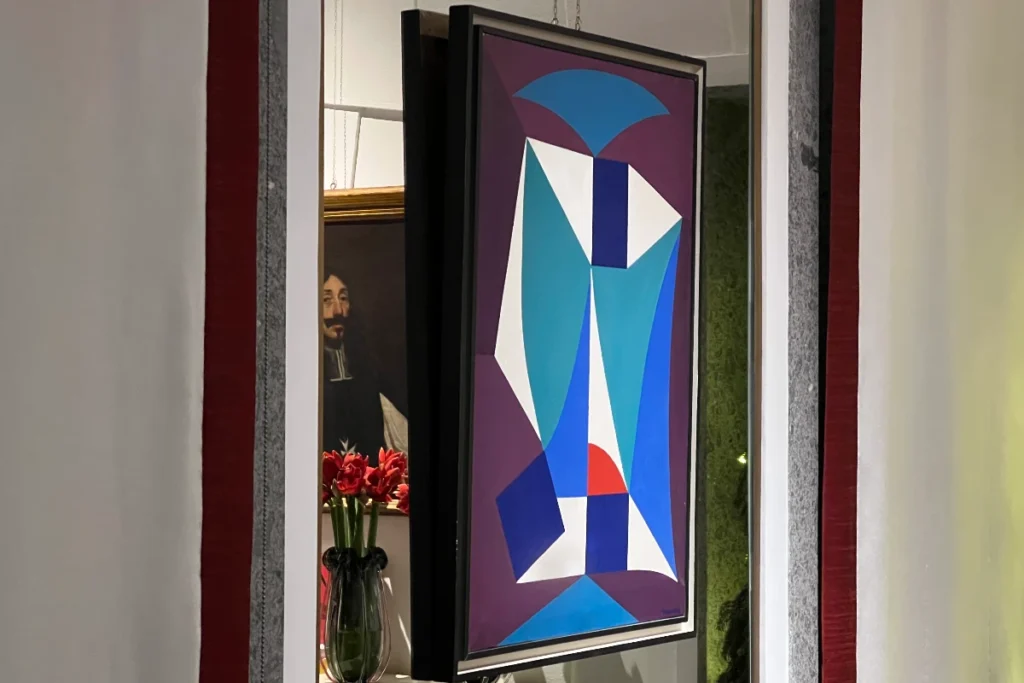
The library, loggia, and ceremonial staircase in Portrait Milano’s historic wing
In the library, rotating elliptical granite columns serve as movable partitions that orchestrate perspectives and pathways. Historic fireplaces with carved stone mantels stand alongside touches of cardinal red, complemented by deep greens that recall the bourgeois interiors of 1950s Milan. A balustraded staircase lit by restored windows leads to the upper floor, where faint episcopal insignias remain as subtle reminders of the building’s origins. Oversized glass doors on bronze hinges convert the monumental Ionic-columned loggia into a winter garden extending around all four sides of the cloister. Stone fountains from the 1930s punctuate the perimeter. Mario Ceroli’s black wooden thrones and wicker-and-rope armchairs designed by Bönan’s studio embody the dual nature of the project—majestic yet intimate, sculptural yet hospitable.
Portrait Milano’s 73 rooms and suites: Calacatta marble, walnut paneling, and Baroque embroidery
Across the hotel’s 73 rooms and suites, ranging from 32 to 165 square meters, the interplay between heritage and modernity becomes especially vivid. Four-poster beds feature geometric embroidery inspired by seventeenth-century Milanese Baroque, complemented by straw and rattan textures, rosewood, and blond walnut paneling. Backlit bookcases provide rhythm and warmth. Bathrooms are clad in Apuan Calacatta marble with retro chrome fixtures; spacious shower rooms are lined with single slabs of Carrara marble, while Devon&Devon bathtubs introduce a vintage note in selected suites. Doors crafted with leather and bronzed brass by Florentine artisans elevate the tactile experience. Vintage lamps and ceramics sourced from Parisian markets infuse each space with nostalgic charm.
Natural larch floors pair with moss-green or garnet carpets inspired by mid-century rationalism and 1970s design, bordered in crisp white. Suites adopt softer palettes—browns, camels, rope, butter, and ivory—with touches of cardinal purple.
The Salvatore Ferragamo archive at Portrait Milano: patents, sketches, and the architecture of the shoe
Portrait Milano celebrates Milan’s legacy as the capital of Italian fashion through archival displays dedicated to Salvatore Ferragamo. Photographs, patents, and sketches illuminate his visionary approach, revealing footwear as an architectural exercise—ergonomic, sculptural, and avant-garde. Michele Bönan often cites Ferragamo as a guiding inspiration, supported by the creative sensibilities of Wanda Ferragamo.
Restaurant 10_11: chef Luigi Cinotti’s Italian cuisine between Via Sant’Andrea and Corso Venezia
The restaurant 10_11 takes its name from its dual entrances at Via Sant’Andrea 10 and Corso Venezia 11. Executive Chef Luigi Cinotti, originally from Tuscany, became Executive Chef in 2023 after joining the team as Sous Chef in 2021. His cuisine is rooted in Italian conviviality, shaped by the flavors of his childhood and refined during six years in prestigious hotel kitchens in the United Kingdom. Extra virgin olive oil, freshly baked bread, and essential ingredients form the backbone of an approach that elevates simplicity through technical mastery.
Executive Pastry Chef Cesare Murzilli, born in Rome, interprets Italian pastry classics with contemporary clarity. His apple tart, millefoglie, and meringata evoke memories of family gatherings while embracing modern textures and presentation. The mixology program completes the experience, reimagining Milan’s aperitivo ritual through a considered blend of tradition and innovation.
Portrait Milano — Corso Venezia 11, 20121 Milan, Italy.