Stationery made in France: Lignon 1895 revives the graphic culture of an Auvergne paper mill that supplied the Lumière brothers, with notebooks, stamps and archive boxes
The 1895 in the name is a date. That year, the Lumière family built a paper mill at Pont-de-Lignon, in Haute-Loire, where the Lignon river meets the Loire. The plant straddled the communes of Monistrol-sur-Loire and Saint-Maurice-de-Lignon. It made the base paper that the Lumière works in Lyon then turned into photographic paper. Meanwhile, in Paris, the brothers held their first public film screening that same year.
Today, Lignon 1895 is a stationery house that takes that mill as its origin. Its first collection covers the objects of a desk, and French workshops make every piece.
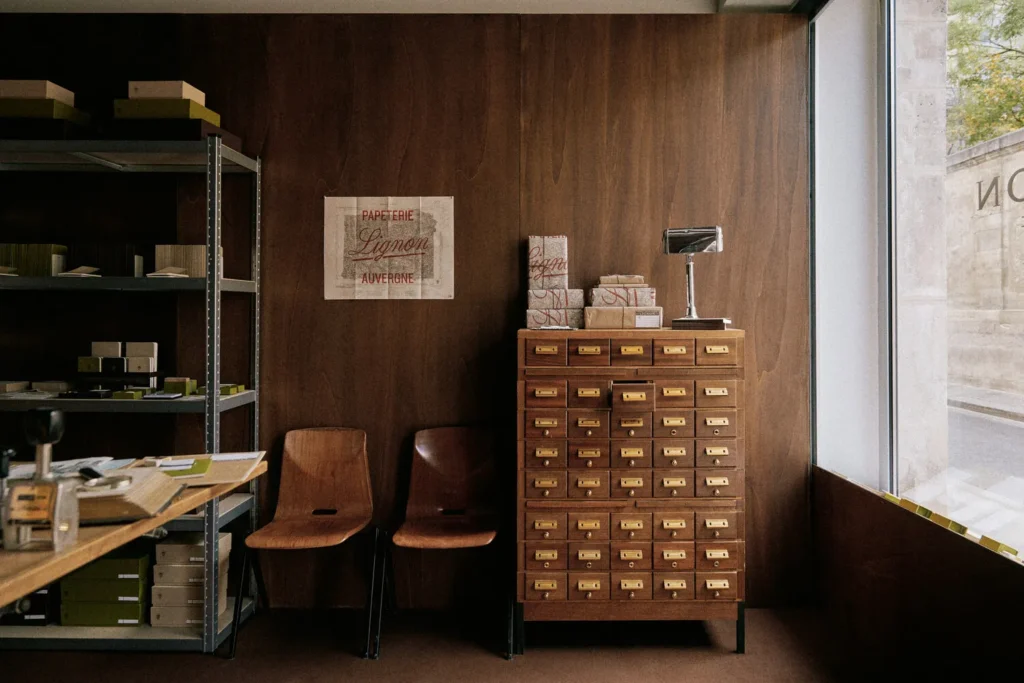
The Papeteries du Pont de Lignon and the Lumière brothers
The Lumière family picked the site for its water. Paper for photography needs water free of minerals and iron, because these stain the emulsion, and the Lignon ran clean. The business operated as the Papeteries de Pont-de-Lignon. In 1900, Auguste Lumière signed one of its share certificates as director. Later, the family sold the company; according to one local history, Hachette bought it in 1926. Eventually the mill closed. Still, it left behind registers, labels, printed forms and packaging.

Romain Chirat and Établissements, a studio for heritage brands
Romain Chirat grew up in his parents’ bookshop and stationery store. In 2016 he founded Établissements, a design studio that works on the visual identity of heritage brands. Its clients include Galeries Lafayette, Hôtel Rochechouart in Paris and La Minerva in Rome for Orient Express. Over the years, Chirat has also collected registers, business cards, industrial catalogues and booklets of typographic labels.
With Lignon, however, the studio reverses its usual job. Normally Établissements gives an old name a current form. Here, instead, it started from a closed factory and a set of printed documents, and built the brand around them. The studio handled art direction, identity, product design and packaging.
“I have always been fascinated by these objects that no one really looked at: a register, a box of photographic paper, a label, or a simple form,” Chirat says. “They weren’t designed to be beautiful, but to be right. It’s probably that restraint that still moves me today. With Lignon, we wanted to recapture that balance between precision, craftsmanship and simplicity, without ever giving in to nostalgia.”
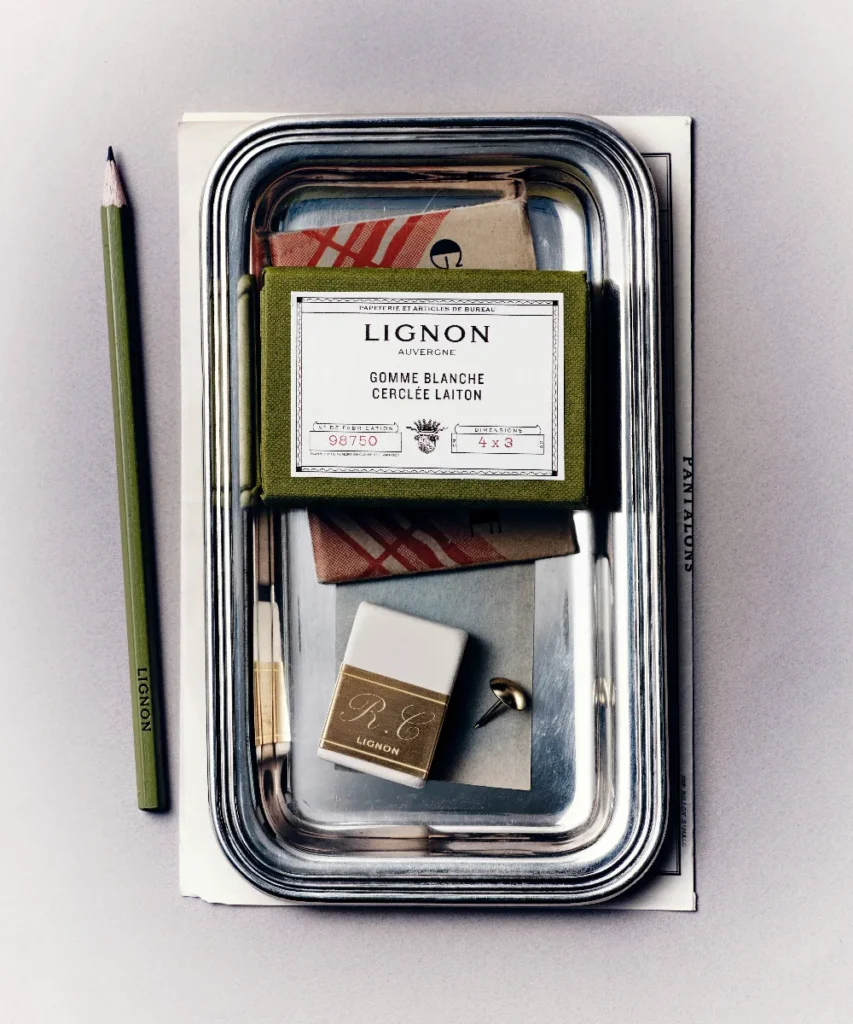
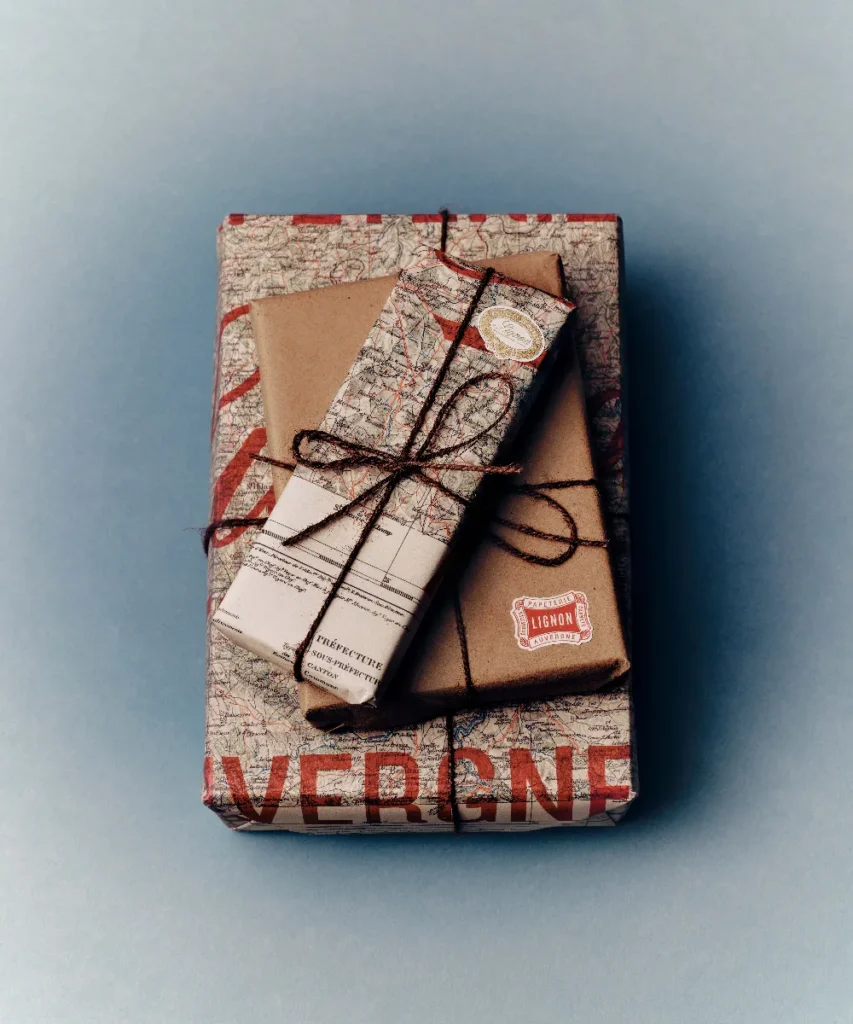
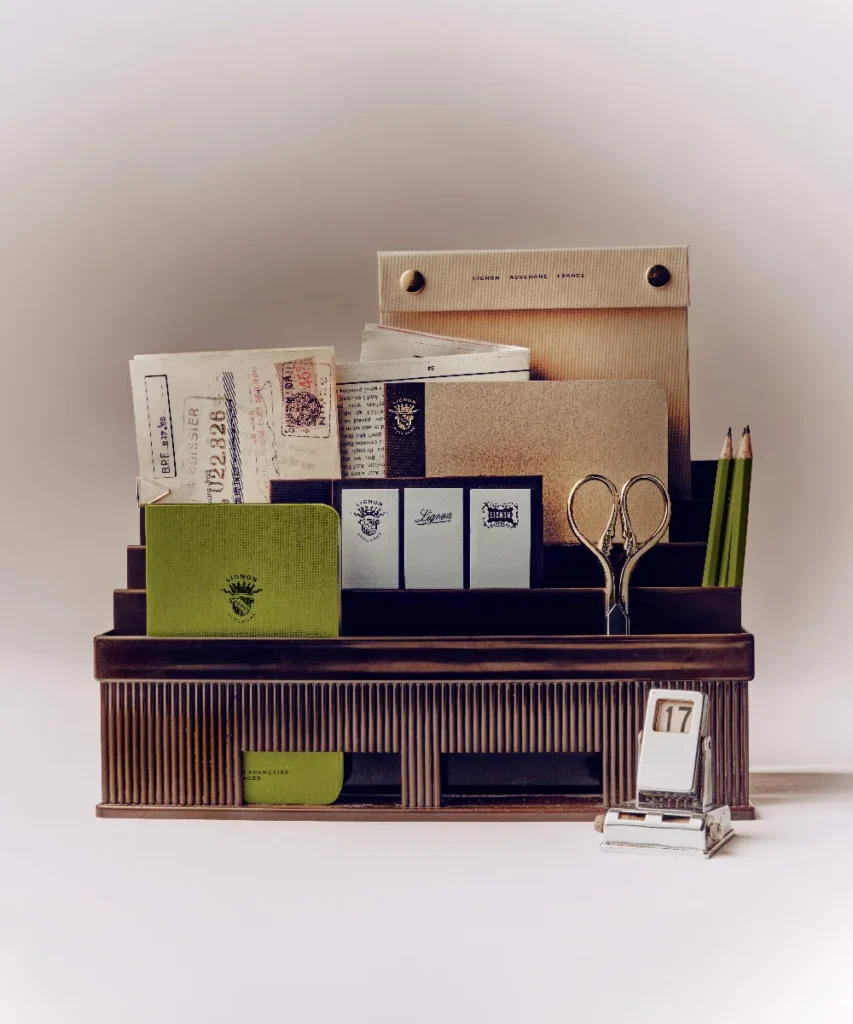
Letterpress, Thiers scissors and rubber stamps: how Lignon is made in France
Several workshops produce the collection, and Lignon matches each object to one of them. First, antique letterpress machines in Auvergne print part of the paper range. Unlike offset, letterpress presses the type into the sheet, so it leaves a slight relief and a denser layer of ink. Next, the scissors come from Thiers, the town in Puy-de-Dôme that has forged most of France’s blades for centuries. Similarly, the alphabet stamps come from one of the last French workshops that still makes them. Finally, specialists take care of bookbinding, cardboard work and cutting.
The Lignon collection: notebooks, correspondence sets, archive boxes
The range follows the office supplies of the mill’s era. There are two notebooks, a pocket format of 48 pages and Le Cahier of 96, in grid, lined or blank paper. The correspondence sets hold five envelopes and five cards, and an engraving of the Lignon valley lines each envelope. Archive boxes come in A5, A4 and A3, and they follow the proportions of industrial models. Besides these, the collection includes a refillable document holder, a box of alphabet stamps, HB paper pencils, triangle paperclips, a label box, and an eraser in a brass ring that takes engraved initials.
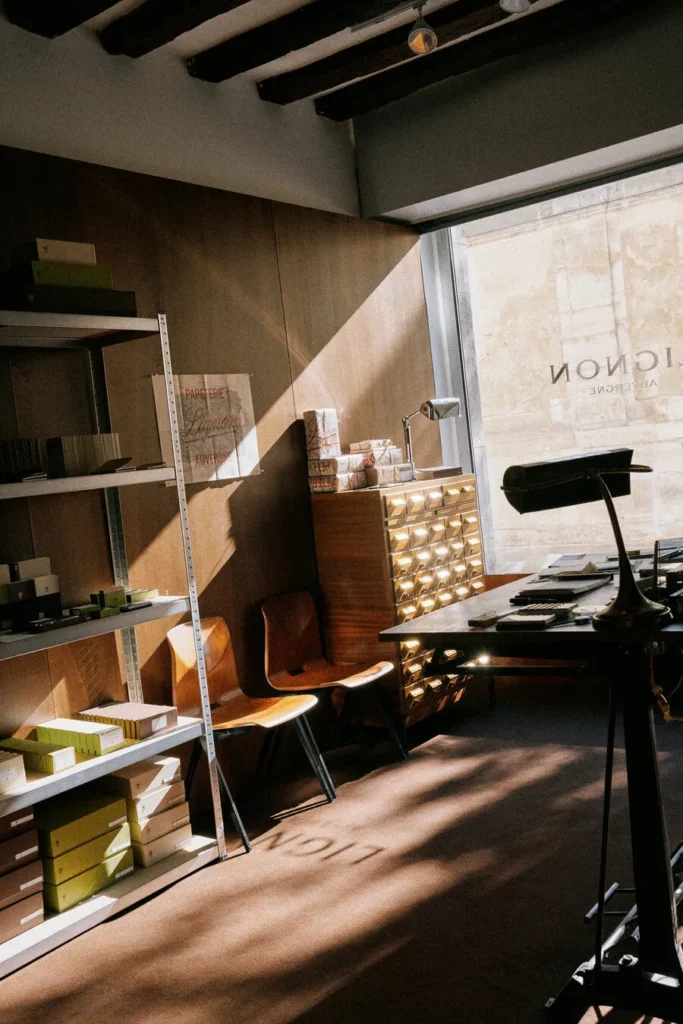
A heritage stationery brand without a heritage to reissue
The house says the collection is not a reissue. In fact, it cannot be one, because the Pont-de-Lignon mill made paper for photographs, not notebooks or scissors. Instead, Lignon takes a place, a date and a graphic vocabulary from it, the one Chirat has collected for years in labels and forms. So the objects are new, while the history works as the frame.
Lignon 1895 sells its collection online at lignon1895.com.