Thirteen years after patenting a composite of textile and wood veneer, the company opened its Milan headquarters under a new name, with two platforms and four new systems
A Milan company that spent thirteen years making wood and metal curve opened its new headquarters on 14 October under a new name. WOOD-SKIN, founded in 2013 by a group of designers and engineers, now operates as Presentform. The founding technology keeps its name as one of two platforms.
The founders were drawing curved shapes that no standard factory could produce. Interiors still default to flat panels and repeating modules, because curved geometry has meant slow, costly, one-off fabrication.
Giulio Masotti, chief creative officer and co-founder, leads the company with Niccolò Vigotti and a team of eleven. The headquarters is at Via Marcantonio dal Re 24, production is in Brianza, and clients are in Europe, the United States and the Middle East.
How a WOOD-SKIN panel folds: textile hinges, wood veneer and PET felt
The founding system is a patented composite. A high-strength textile is bonded to wood veneer, PET felt or another finish: the textile works as a hinge, the rigid material as a facet. The panel folds, twists and bends into complex shapes with no traditional jointing. Panels reach the site numbered, with assembly maps.
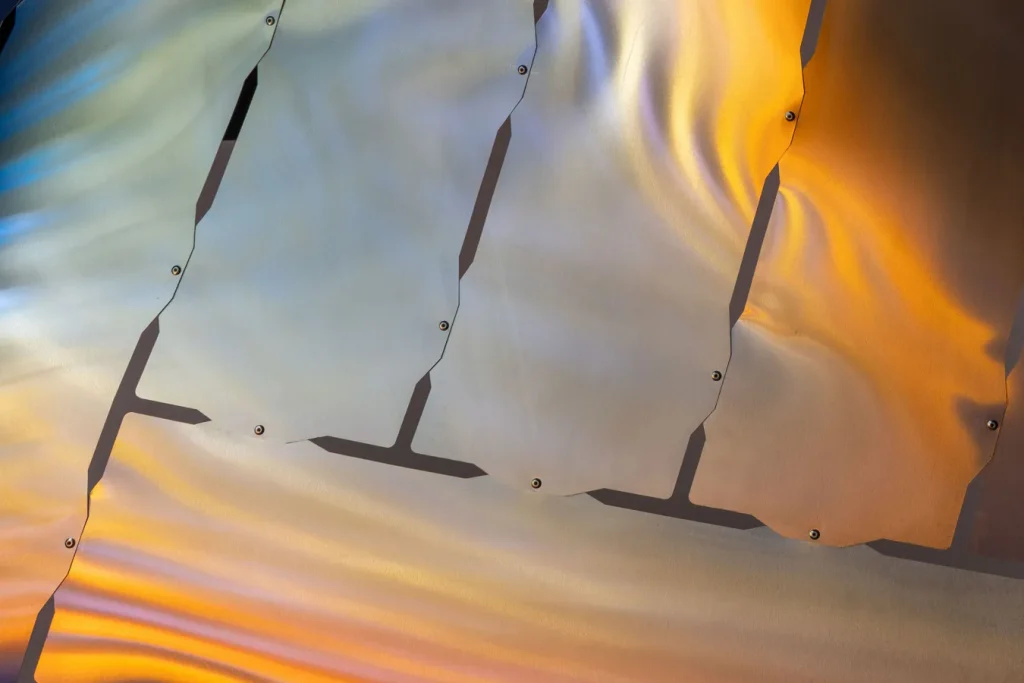
Metal Morphologies, the second platform, does the same in aluminium and other metals, producing folded, perforated and sculpted surfaces at architectural scale. Both run through one design process and one Italian production chain.
AI Render Studio and the Configurator, from rendering to production package
AI Render Studio drops a three-dimensional wall or ceiling into an existing rendering or photograph, or generates one from a written description. The Configurator turns that design into a production package: components, assembly maps, installation documents, panels engineered in the chosen material.
There are two routes. Ready-to-spec modular systems, with set patterns, defined acoustic performance and fast installation. Or freeform solutions, where geometry, density, materials and finishes are drawn for the project. Lighting, speakers, acoustic treatment and building services can sit inside the surface.
QUADRO, Silhouette, Streamline and Segmenta, the four new systems
QUADRO rethinks the coffered ceiling, a grid of square cells that curves inward or outward, so depth and light change with the hour and the viewing position. Cells can be perforated for light or sound. In the freeform version the square disappears and the geometry runs continuously from ceiling to wall.
Silhouette hangs circular elements in sequence, each with a felt face that absorbs sound and a wood face that reflects it. Density and arrangement set the result, from a small cluster to a full installation.
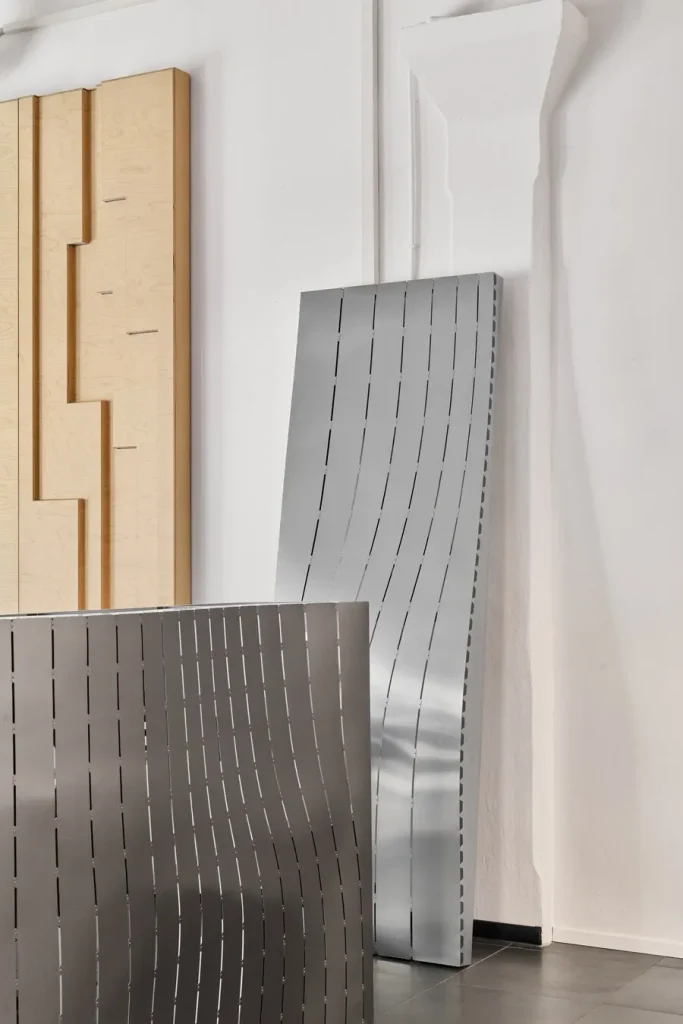
Streamline builds a surface from metal strips laid along a direction and a curve, reading as undulating or sharply linear. Segmenta projects individual metal elements out of the plane, producing relief and shadow that move with the light. Both come in modular and freeform versions, in any aluminium finish and colour.
Room XIX in Geneva, Twiga in Monte Carlo, MAN in Nuoro, Deloitte in Milan
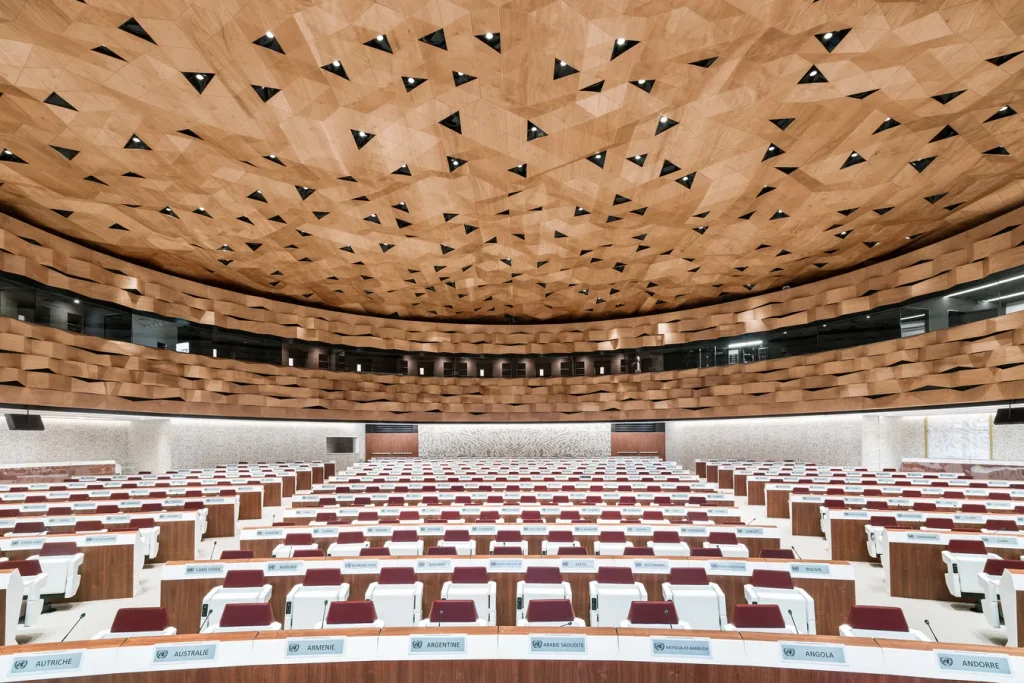
Room XIX at the Palais des Nations, the United Nations headquarters in Geneva, carries a wood composite surface across its dome and walls, designed by the Milanese studio Peia Associati as a field of continuous wooden dunes. The membrane covers about 1,000 square metres in okoumé plywood with a clear coat, inside a hall of 4,000, and it answers one of the most demanding acoustic briefs in the complex: the irregular surface diffuses sound against echo, while the textile core absorbs the low frequencies. The renovation was paid for by a donation from the State of Qatar.
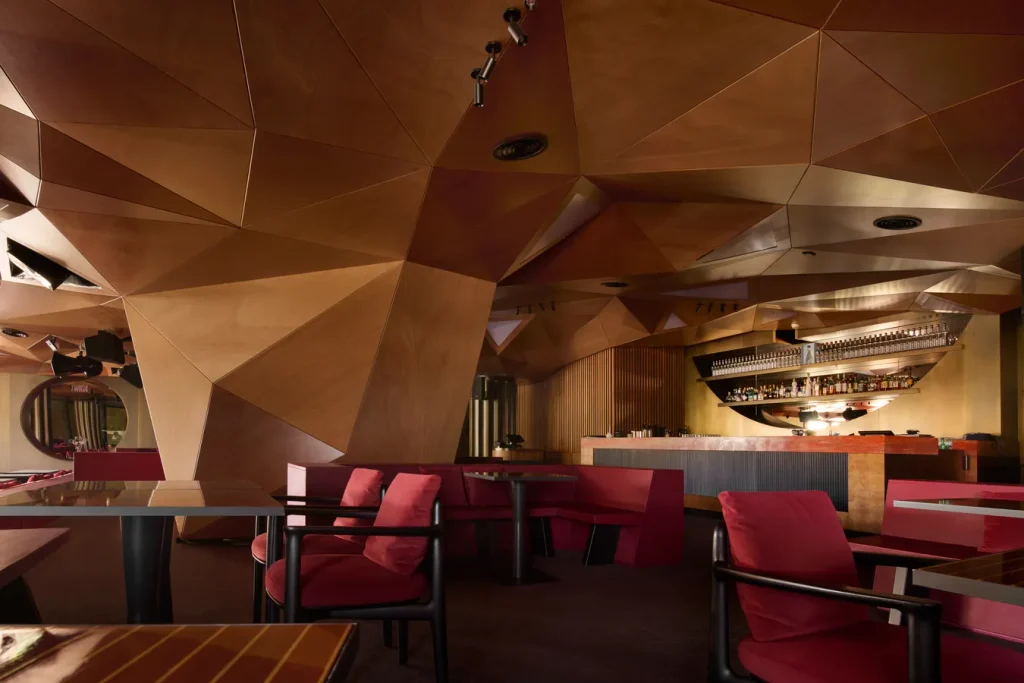
At Twiga Club in Monte Carlo, designed by Stefano Belingardi Architects, a tessellated ceiling takes the same panels to full scale in a nightclub. At MAN, the Museo d’Arte Provincia di Nuoro, Metal Morphologies produced a metal surface designed by Pininfarina Architecture. For Deloitte, in the Solaria offices in Milan and Rome designed by the Milanese practice Lombardini 22, a track structure across ceiling and wall carries 350 metal mesh panels, each calibrated for geometry, profile and colour and assembled into a single arch.
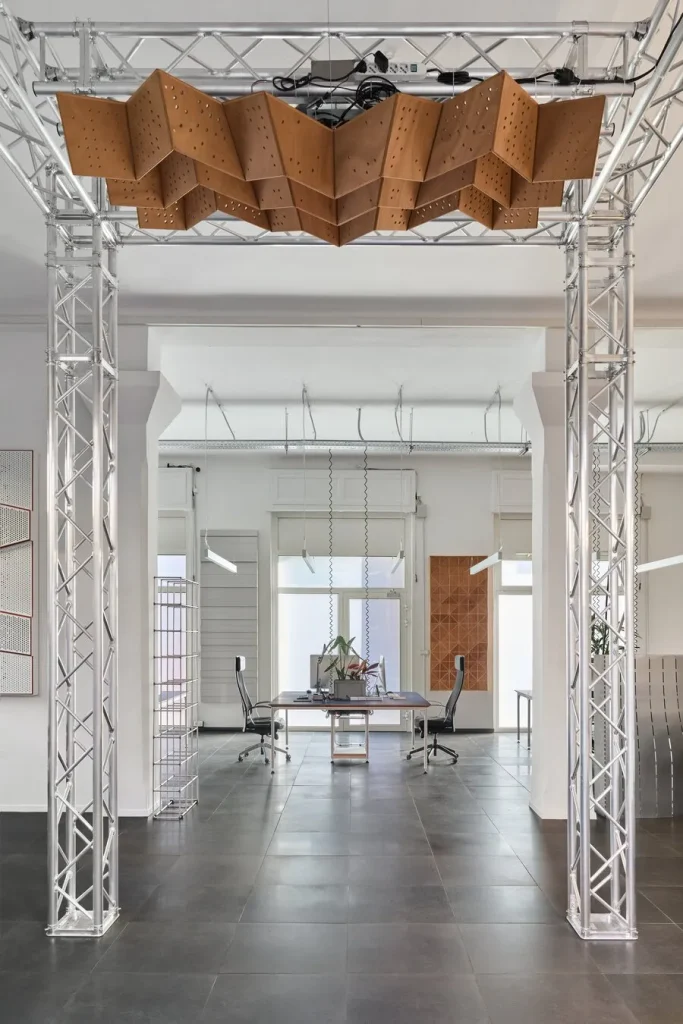
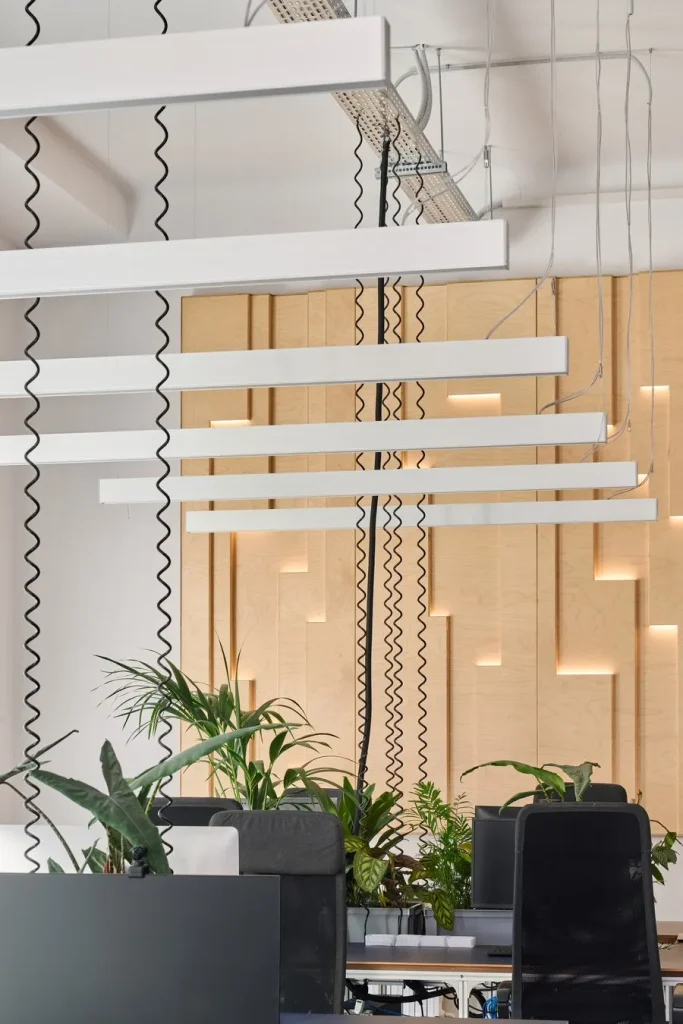
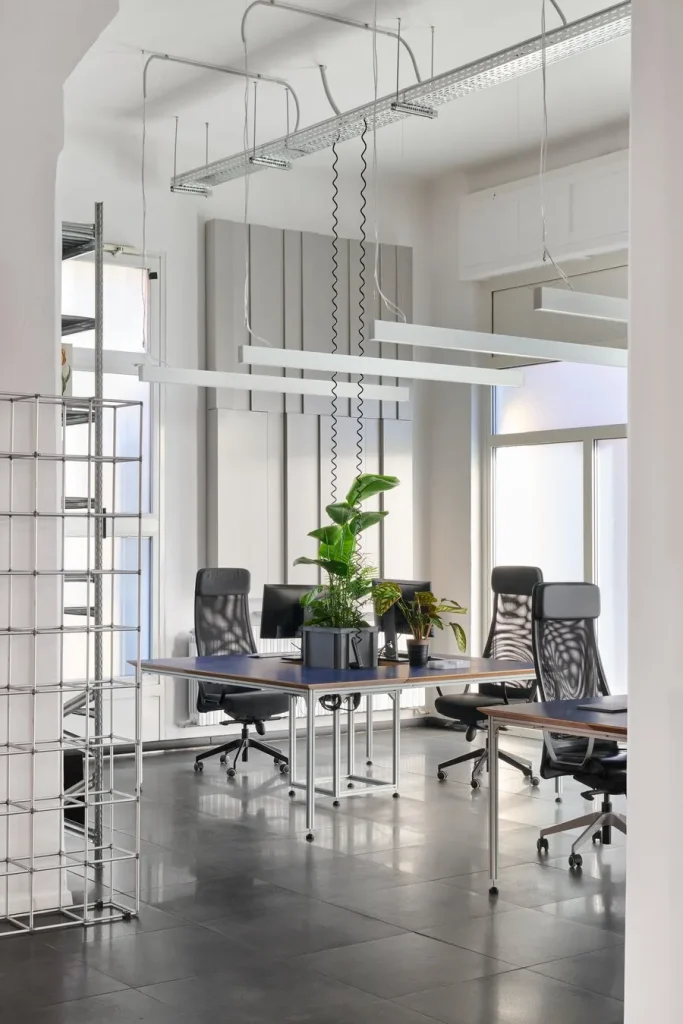
The Milan showroom in Via Marcantonio dal Re, mock-ups instead of displays
The Milan space is built around mock-ups. An architect arrives with an idea and sees it made as a sample, then judges the material and the finish on the piece itself, at the point where a folded surface either holds its shape or loses it.
Founded 2013 as WOOD-SKIN, renamed 2026. Headquarters in Milan, production in Brianza, eleven people, two patented platforms, clients in Europe, the United States and the Middle East.