A 43-centimetre blown-glass block from the Bottega Veneta show enters 6:AM’s collection. Alone it is a seat; repeated, a building element. Online from today in 10 colours
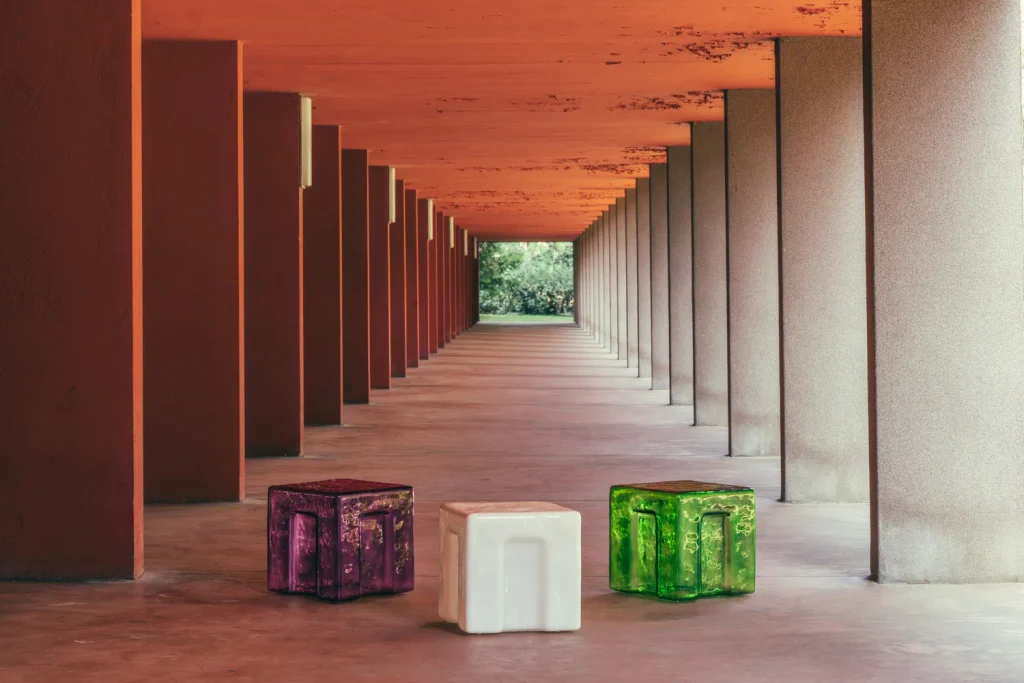
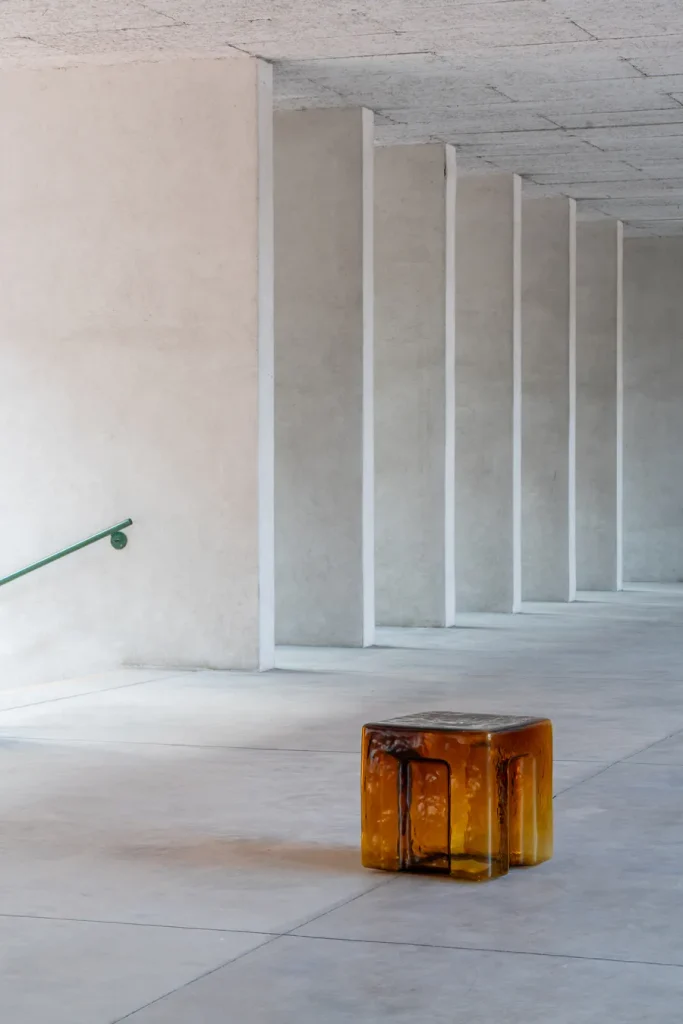
In September 2025 the audience at Louise Trotter’s first show for Bottega Veneta sat on blocks of Murano glass. From today those blocks are a product. 6:AM has put Batch into its permanent collection and online: a blown glass cube of 43 × 43 × 43 centimetres, in 10 colours — Cristallo, Terra, Rubino, Bianco, Verde Chiaro, Verde Antico, Ambra Scuro, Nero, Acciaio and Rosso.
At the show the cubes were set out in a colour gradient and carried the weight of the guests for the length of the collection. The first public presentation of the project on its own terms came at Milano Design Week 2026.
How it is made: a cast-iron mould cut by CNC
Two processes meet in the object. The glass is blown into a cast-iron mould engraved with CNC technology, so the form is not added but removed: the drawing exists first, cut into the metal, and the glass fills it. 6:AM compares the logic to the rough-hewing of marble, where the block is reduced until the figure appears.
The surface keeps the record of the blowing. It undulates slightly, and the irregularity is what separates one piece from the next and what makes the light work, entering the glass and leaving it deflected.
The name comes from the trade. In glassmaking, a batch is the mixture of raw materials loaded into the furnace before melting: the point at which separate components become one material.
126 modules: when the object becomes a surface
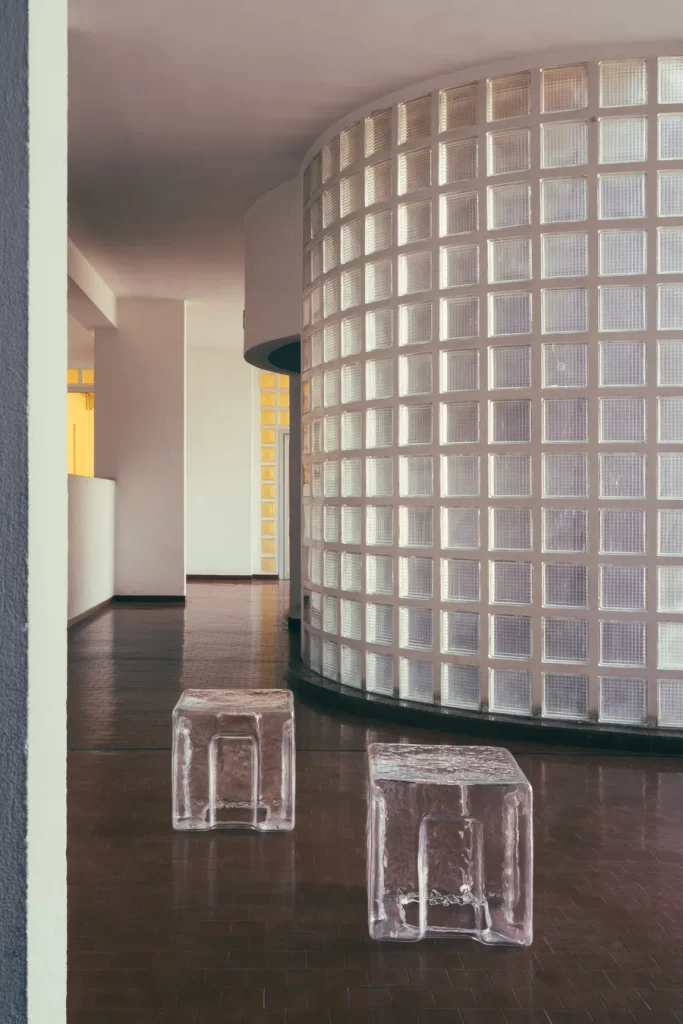
For the presentation the module was repeated 126 times to build a vertical glass wall, held by a plain steel structure. The result is a transparent field made from a single object, in which the undulations of each face multiply reflections and distortions. At the centre, a sequence of coloured elements breaks the transparent grid.
That is the argument of the project. On its own, the cube is a stool or a low table. Repeated, it stops being an object and becomes a surface, which is to say a building element. What changes between the two conditions is not the piece but the number.
The campaign at Monte Amiata, by Aymonino and Rossi
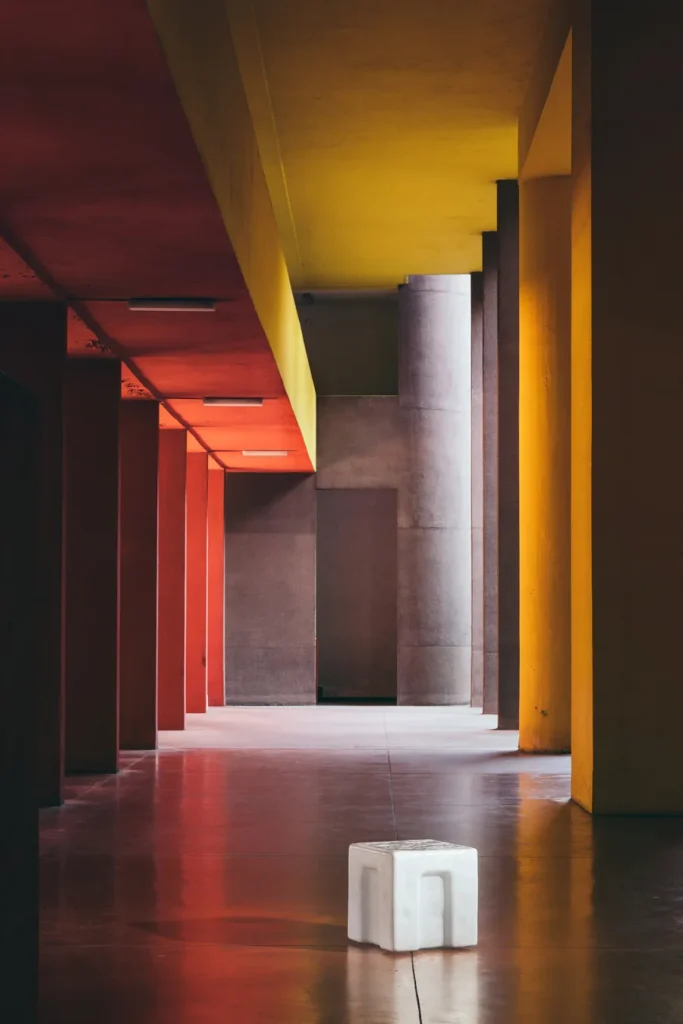
The launch comes with a photographic campaign by Delfino Sisto Legnani, shot at the Monte Amiata housing complex in the Gallaratese district of Milan.
The choice follows the same reasoning. Designed by Carlo Aymonino with Aldo Rossi and under construction from 1967, the complex is made of 5 red buildings linked by passages, bridges and lifts, with an amphitheatre and 2 triangular squares; Rossi signed one of the blocks, Aymonino the others. It is architecture built by repeated elements and by aggregation, conceived as a small city inside the city, with a declared reference to Le Corbusier’s housing unit in Marseille.
Photographing a modular object there sets it against the same logic at the scale of a building: identical units that, multiplied, produce space.
6:AM, from Murano to Milan
The brand was founded in 2018 by Edoardo Pandolfo and Francesco Palù. It is based in Milan, its production stays tied to Murano, and the name refers to the hour at which the glassmakers light the furnaces.
The studio works at a specific point in the field. It uses the techniques of the Venetian tradition — blowing, hand finishing — and directs them towards objects made for architecture and lighting instead of the collector’s vitrine. Batch takes that position to its conclusion, since the piece is not a vase or a lamp but a solid volume, usable as a seat, a surface or part of a wall.
Batch is available through the 6:AM website.