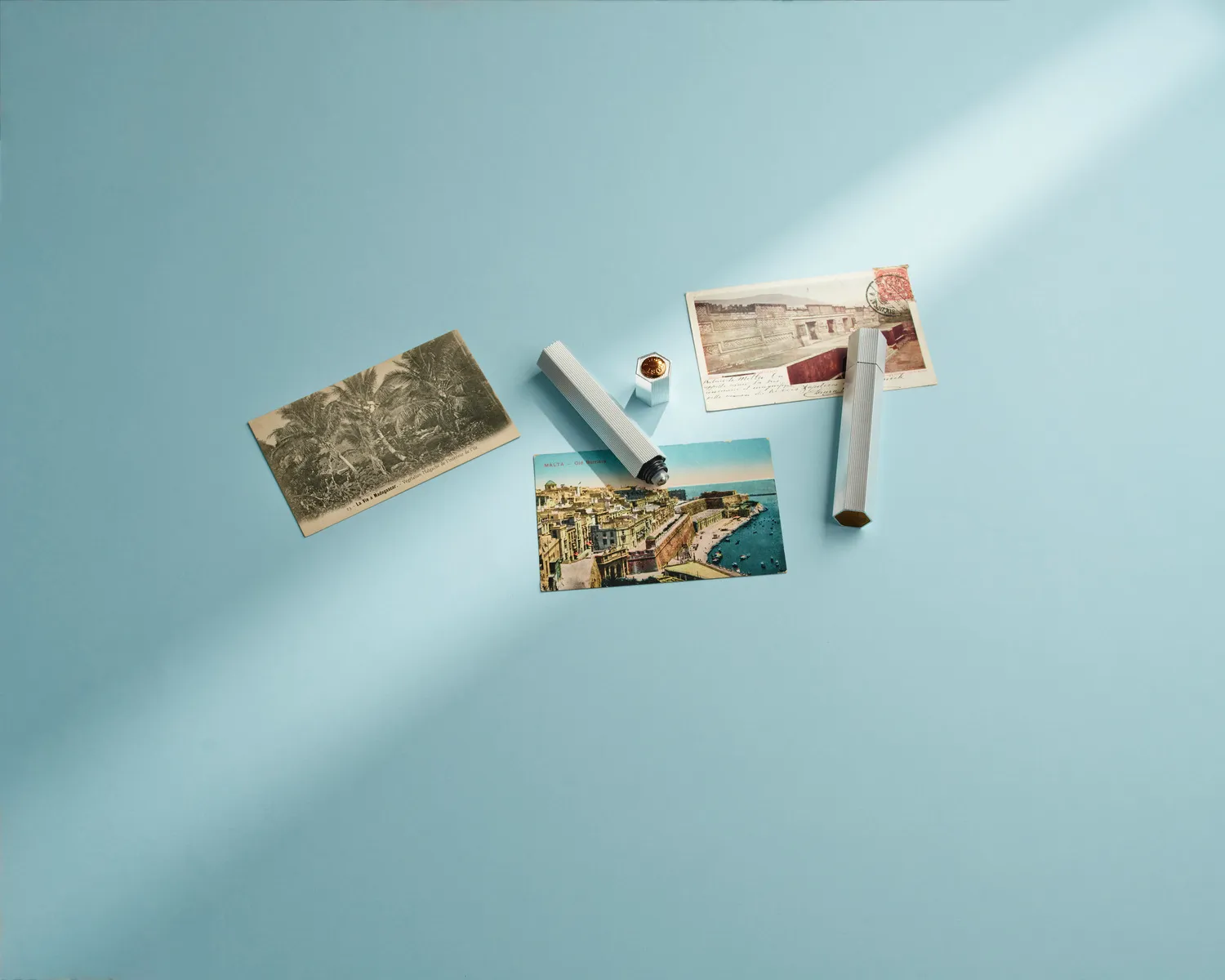
After four years of works, Belgium’s largest design museum has reopened. Inside: a collection display of 500 objects, an exhibition on the design of democracy, and a director on her way out
Design Museum Gent reopened on 3 October, after four years of building work. The new wing covers 2,200 square metres, alongside 6,400 square metres of restored historic buildings; the museum now totals around 6,500 square metres, of which 3,700 are exhibition space. With a collection of 24,000 objects, it holds both the largest design collection in Belgium and, now, the largest floor area.
The reopening runs to 11 October, with more than 120 activities, over 80 participating makers, five exhibitions inside the museum and ten across the city. The whole museum was free during the opening weekend; from 5 October a standard ticket costs €15. The museum expects 125,000 visitors over the year, and 65,000 of them during these nine days.
The new Design Museum Gent wing: Carmody Groarke, timber and white brick
The wing was designed by the London practice Carmody Groarke with ATAMA, while RE-ST handled the restoration of the listed buildings, which date from the sixteenth to the twentieth century. Ney & Partners was the structural engineer, Boydens Engineering handled building services and Daidalos Peutz the acoustics. The client was sogent, the City of Ghent’s development agency, with Brenda Schotte as project manager.
The building is in timber and white brick, on a compact footprint with wide openings at ground level. It introduces six zones: an art-handling area in the basement, visible to visitors; the Stadskamer, a freely accessible city room with reception and shop; the Forum for lectures; the Atelier for workshops; the Vitrine for temporary shows; and the Loft on the fourth floor, an event space with views over Ghent.
Its other function is connective. The site had grown as a fragmented ensemble around Hotel de Coninck, the eighteenth-century house organised around its inner courtyard, with a derelict southern passage and an unused plot in the middle. The new wing closes that gap, turns the courtyard into a garden and uses it as the orientation point for a new route through the galleries, including the 1992 wing.
The Gent Waste Brick: 63 per cent city waste, no kiln
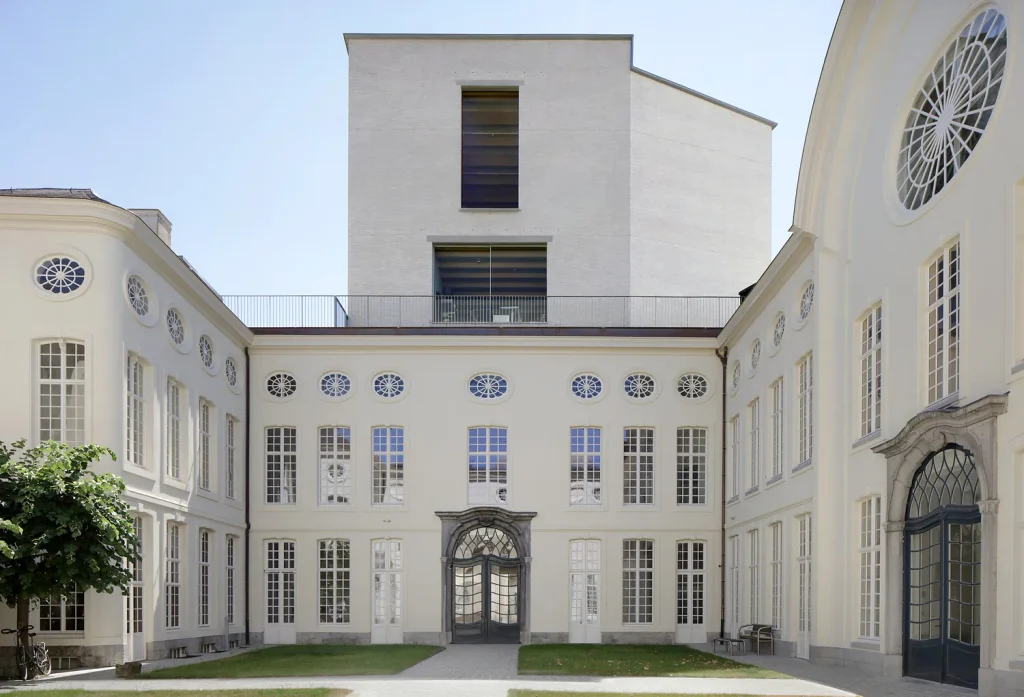
The façade is the most documented part of the project. It uses the Gent Waste Brick, developed for this building by Carmody Groarke with TRANS Architectuur Stedenbouw, the circular-economy consultancy Local Works Studio and the Brussels manufacturer BC Materials, with sogent and the museum. More than 82,000 bricks were produced at Het Arsenaal in Ghent, on a site where residents could watch the process.
The composition is 63 per cent recycled municipal waste from Ghent — crushed demolition concrete and recycled glass — with sand from Lommel, a hydraulic lime binder and ground calcium carbonate. The bricks are not fired. They cure for two weeks in a humid environment and then air-dry, gaining strength through mineral carbonation, a reaction with atmospheric CO2 that continues once the brick is in the wall. Embodied carbon is 0.17 kg CO2e per kilogram, about a third of a standard Belgian fired clay brick. The bricks were approved for building use in September 2022, and the material took a Henry van de Velde Award in 2024.
Two decisions tie the façade to the street. The brick dimensions follow those used in the eighteenth-century Hotel de Coninck, and the white refers to the historic houses along Drabstraat. The massing refers to Ghent’s guild houses and patrician residences, with deep window reveals and pronounced copings.
The collection display: Design Museum Gent returns to its 1903 model museum
The new permanent display, Collection. Models from the Past for the Future, is curated by Evelien Bracke with assistant curator Benoît Vandevoort. It shows around 500 objects, 40 per cent of which have never been exhibited.
Its premise is institutional history. The museum was founded in 1903 as a model museum, assembling good examples to instruct craftspeople. The display returns to that brief and groups the collection under five contemporary themes — copy, comfort, migration, folding, connections — asking which of those models still hold. Names run from Henry van de Velde, Victor Horta, Gustave Serrurier-Bovy and Paul Hankar to Alvar Aalto, Charles and Ray Eames, Arne Jacobsen, Ettore Sottsass, Alessandro Mendini, Gaetano Pesce, Maarten Van Severen and Eva Zeisel, alongside less familiar figures including Mabel Elwes, Yvette Lauwaert and Elza Van huffel-Gallet.
The scenography, by the studio Nord with Laura Muyldermans, puts traditional clay-plastered walls next to Skellet, a Belgian circular steel construction system. Three designers — Kana Arioka, OpenStructures and Victor Verhelst — have made new work from the collection’s themes. Two books accompany the display, published by Lannoo at €49.99 and €24.99, or €69.99 together.
Public Matter(s): Design and Democracy at Design Museum Gent
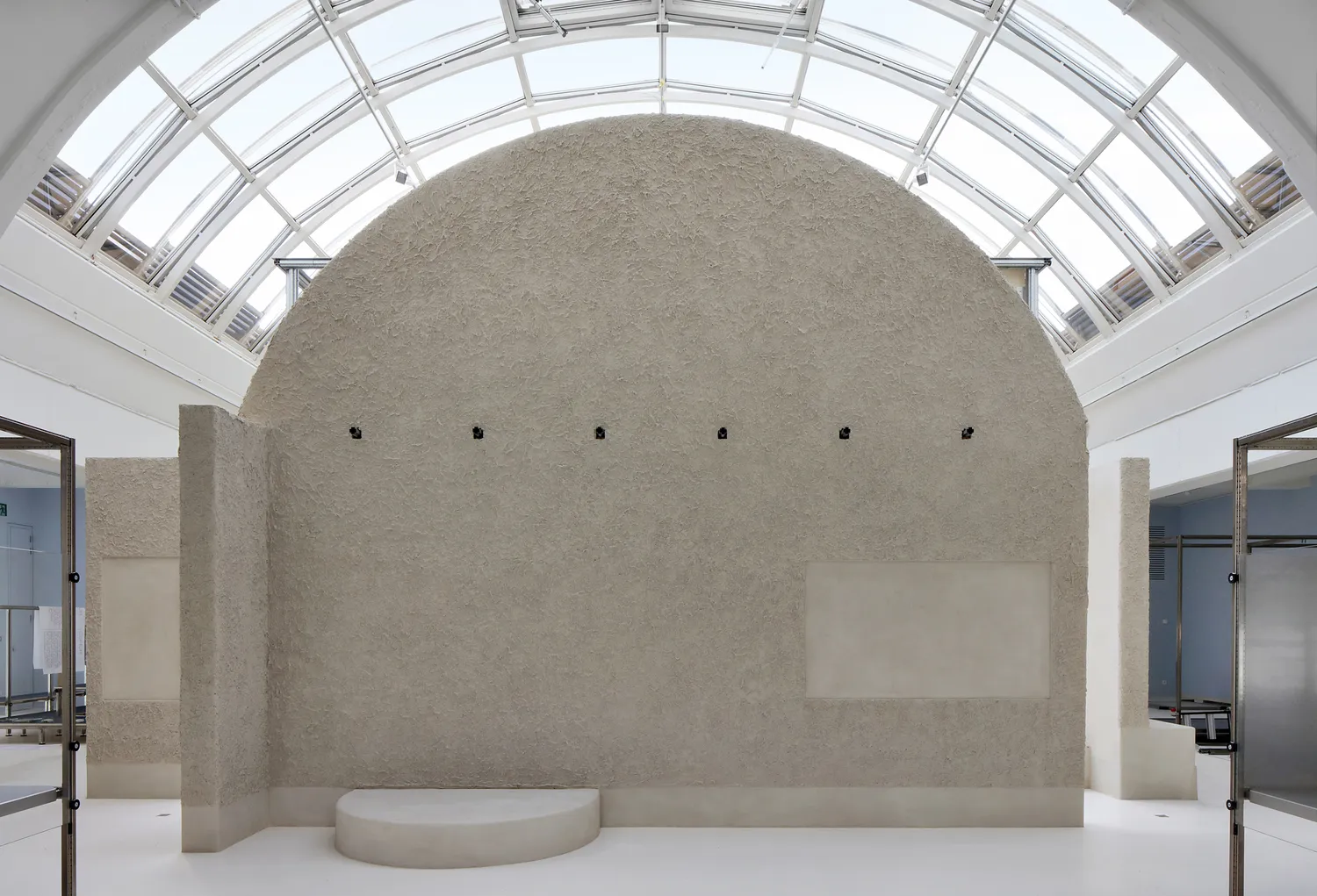
The opening exhibition, Public Matter(s): Design and Democracy, runs to 11 April 2027, curated by Amelie Klein and Vera Sacchetti with assistant curator Stefanie Heyvaert, scenography by Elmēs and graphic design by Sara De Bondt.
Its subject is the designed nature of democratic machinery: ballot papers, parliamentary buildings, party representation, the mechanics of voting. It examines access — how homeless people or visually impaired voters reach an election — and the history of exclusion, from women’s suffrage to civil rights, treating protest and activism as design practices. It also tests newer models, including ecocracy, which extends legal and constitutional rights to nature.
At its centre is The Democracy Workout, an installation route for practising skills the exhibition treats as trainable: active listening, finding compromise, tolerating conflict. The framework comes from DE40, a citizens’ panel of forty Ghent residents convened in spring 2025 to work on how the museum could make design relevant regardless of background. Its recommendations also shaped the wider reopening.
Searcher: navigating Design Museum Gent’s 24,000 objects by colour and form
Studio Digitaal, the museum’s strand on digital culture curated by Olivier Van D’huynslager, opens with Searcher, an installation by Jon Stam, Valentin Vogelman and Boris Smeenk, with scenography by Olivier Goethals.
Since the collection cannot be shown physically, Searcher uses artificial intelligence to move through it by similarity in form, colour and text instead of by maker, period or material. The project was supported by the European Regional Development Fund and the EU’s Creative Europe programme.
Special Design Projects: design built into the building
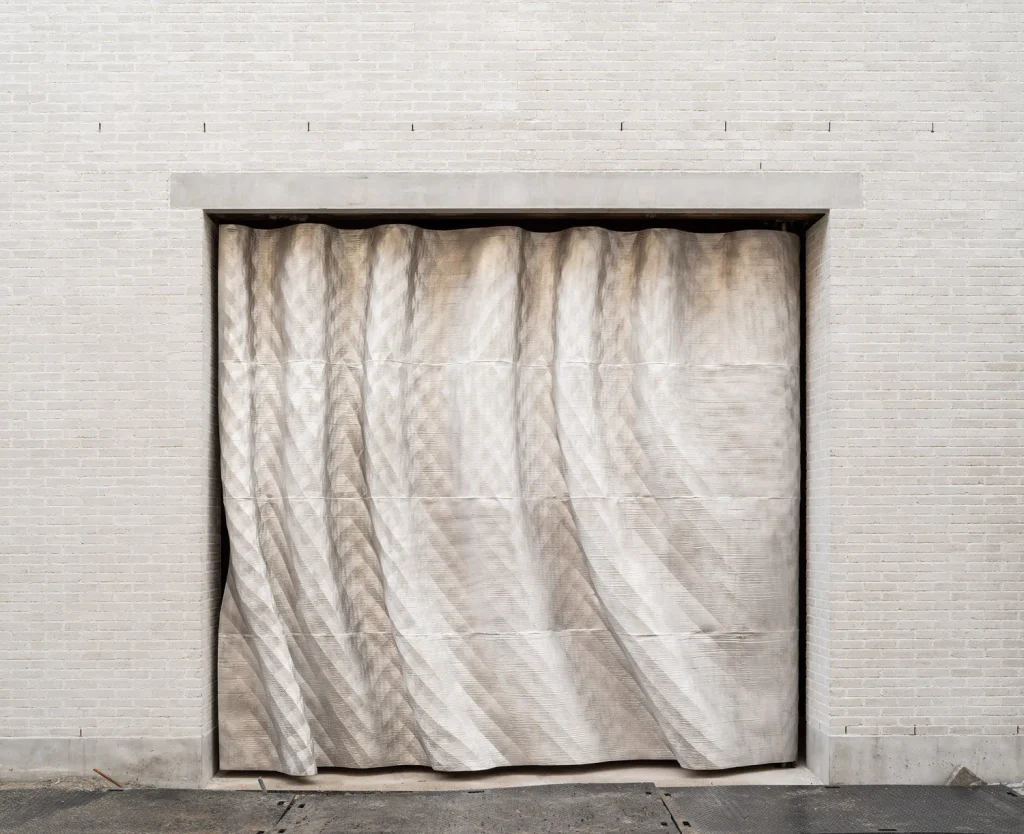
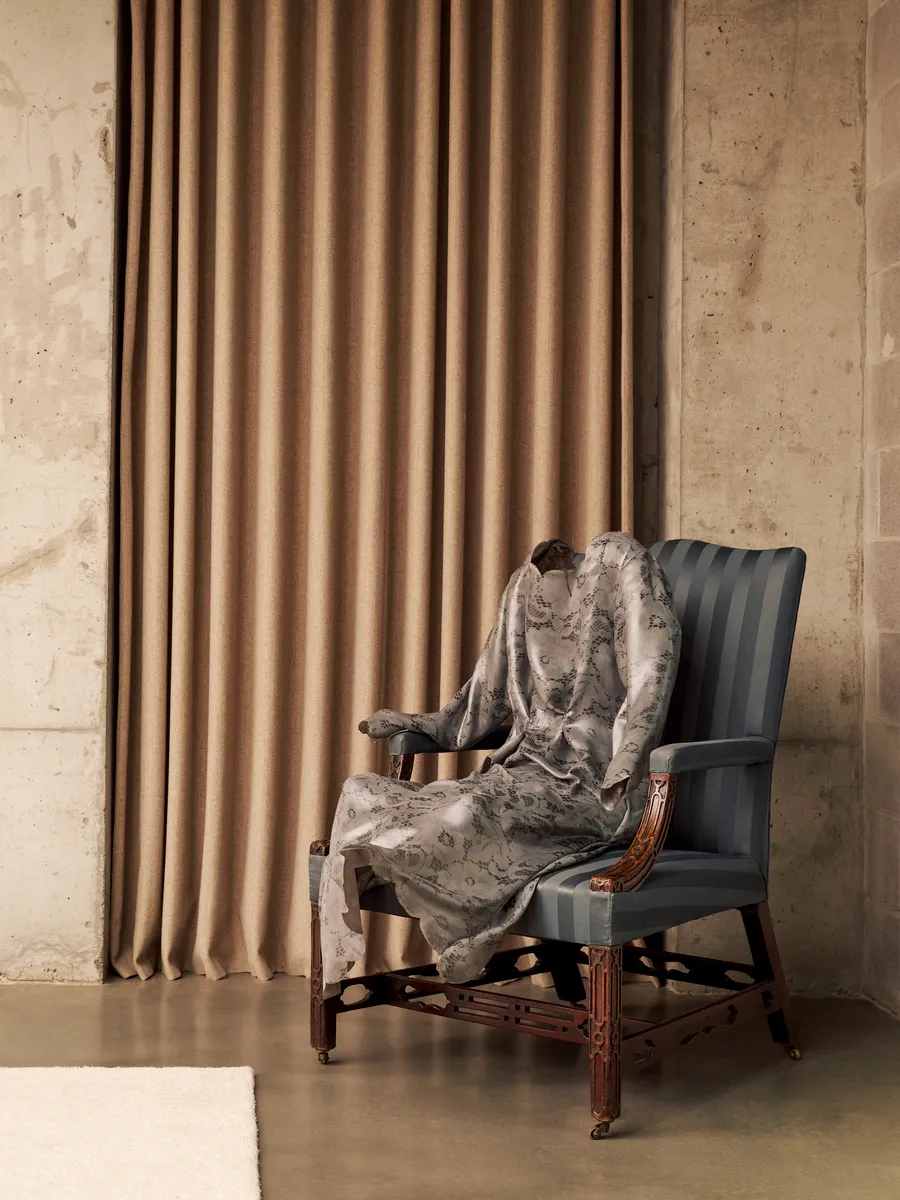
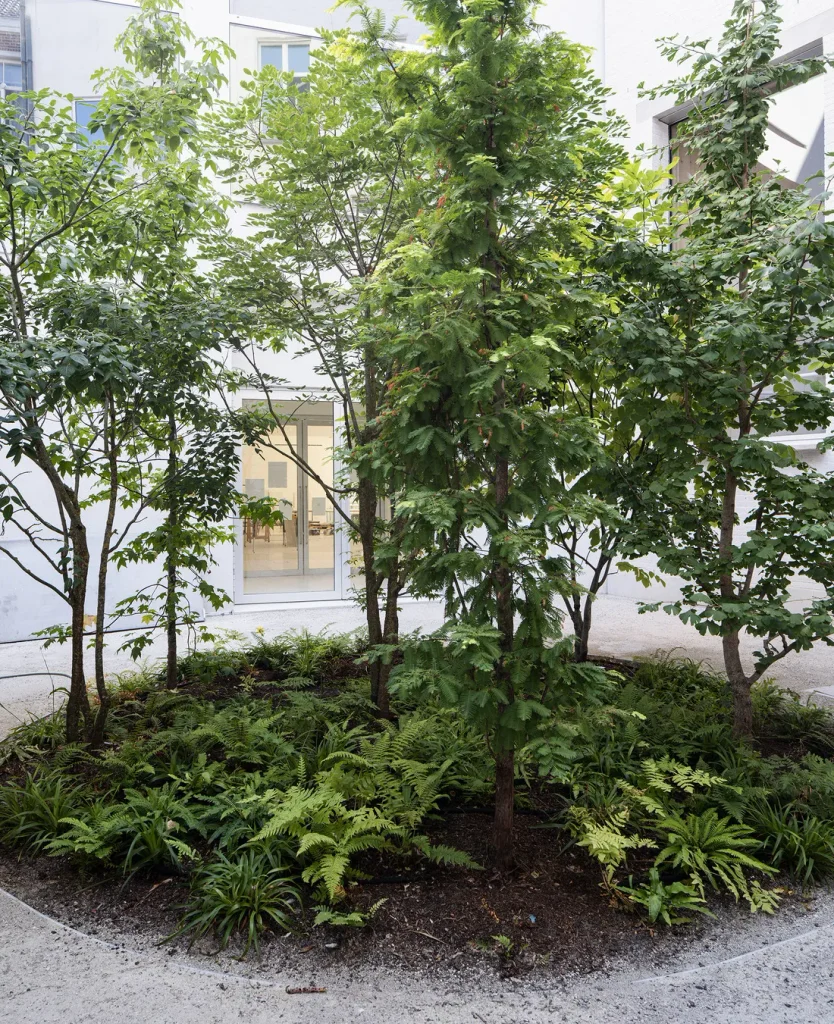
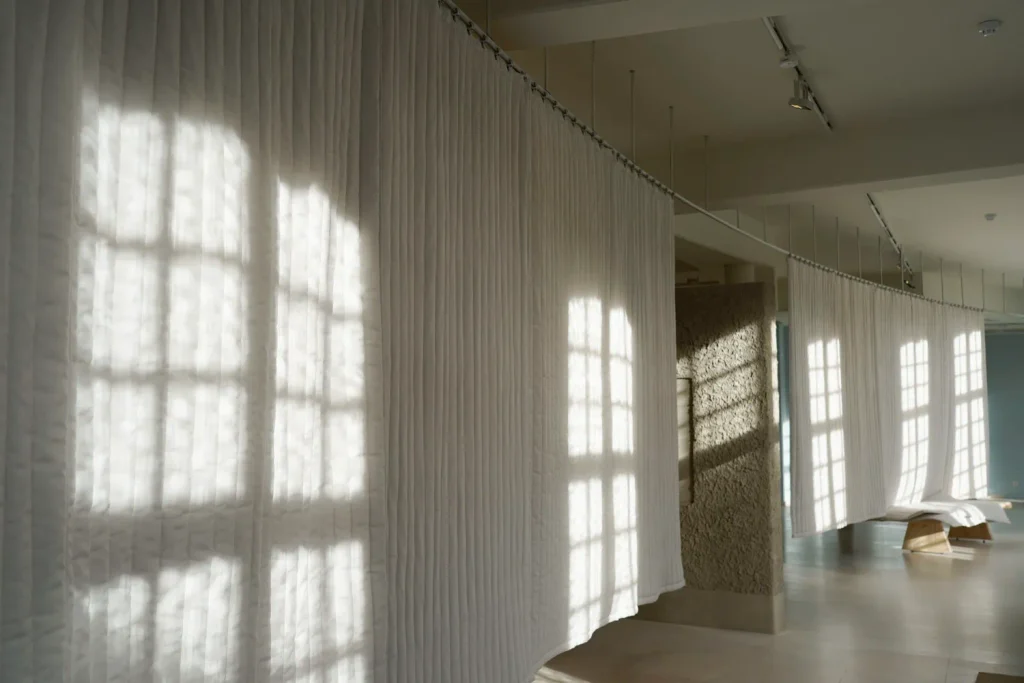
Around fifteen commissions, curated by Siegrid Demyttenaere, are built into the building itself, from the reception desk to the toilets: furniture by Casimir and by Bram Vanderbeke with Wendy Andreu, a cooling forest by the landscape architect Bas Smets, acoustic curtains by Chevalier-Masson, and Freeze Frame 82.2, a 3D-printed aluminium entrance gate by Unfold.
Design Fest Gent: ten exhibitions across the city
From 5 to 11 October the programme moves outside, with Design Fest Gent, also curated by Demyttenaere, under the title All Our Voices. Together!
At BROEI, WE ARE THE NEXT GENERATION, an initiative Designregio Kortrijk has run since 2014, shows around twenty graduation projects selected by jury. On the Fluvius site, A Place In Motion puts eight practices — among them aequo.design, Manoeuvre, LouLou João and Design for Impact — and LUCA School of Arts students to work with residents of the neighbourhood. At Trefpunt–Bar Edward, Common Ground gathers six makers around reuse and repair. In the former provincial government building, Under Construction shows furniture and installations that leave their construction visible, while Cavea, by BRUT Collective and DesignUnDisciplined, takes over the historic council chamber and works on its seating, in a building designed to separate people by rank. At the Dada Chapel, a former convent turned distillery, Sharon Van Overmeiren shows sculptures under the title LOHO Collabs. Around thirty shops across Ghent have turned their windows into displays for Windows of Design.
Katrien Laporte leaves Design Museum Gent
Katrien Laporte has been director since October 2013. She put the long-postponed wing back on the agenda and secured the political and financial backing for it. “This expansion and renovation are not about creating more museum, but about creating more than a museum,” Ms. Laporte says of the result. She leaves the museum on 31 October.
Design Museum Gent, Drabstraat 10, Ghent. Standard ticket €15, groups €13. Monday to Friday 9.30am–5.30pm, weekends and school holidays 10am–6pm, closed on Wednesdays.