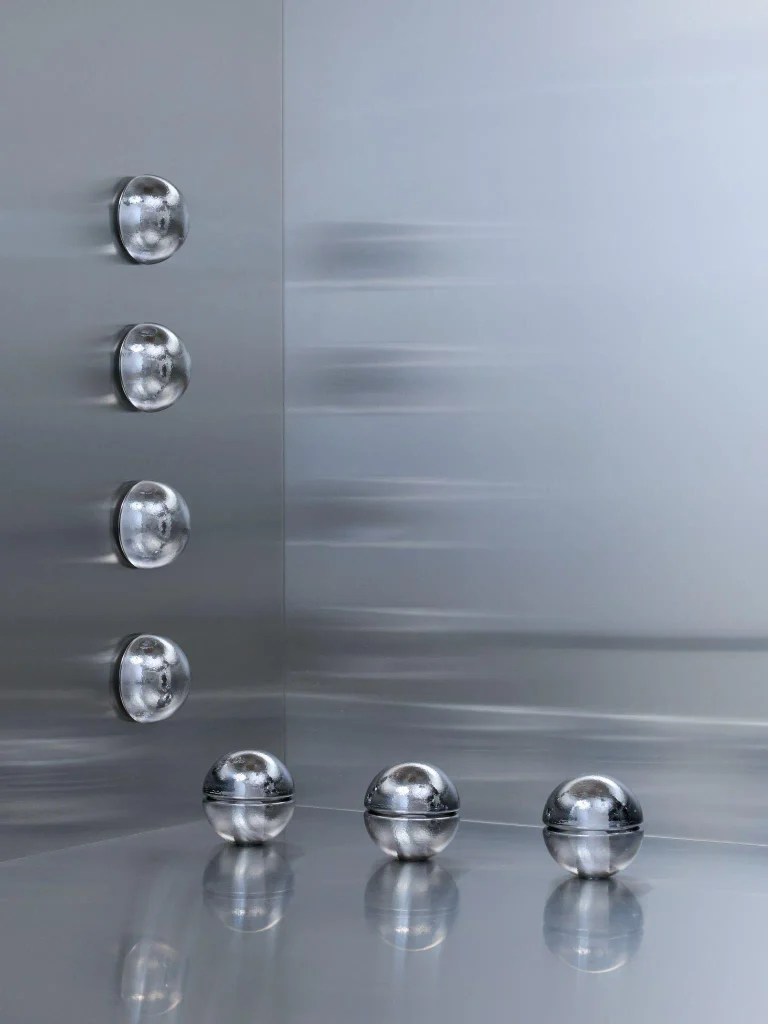
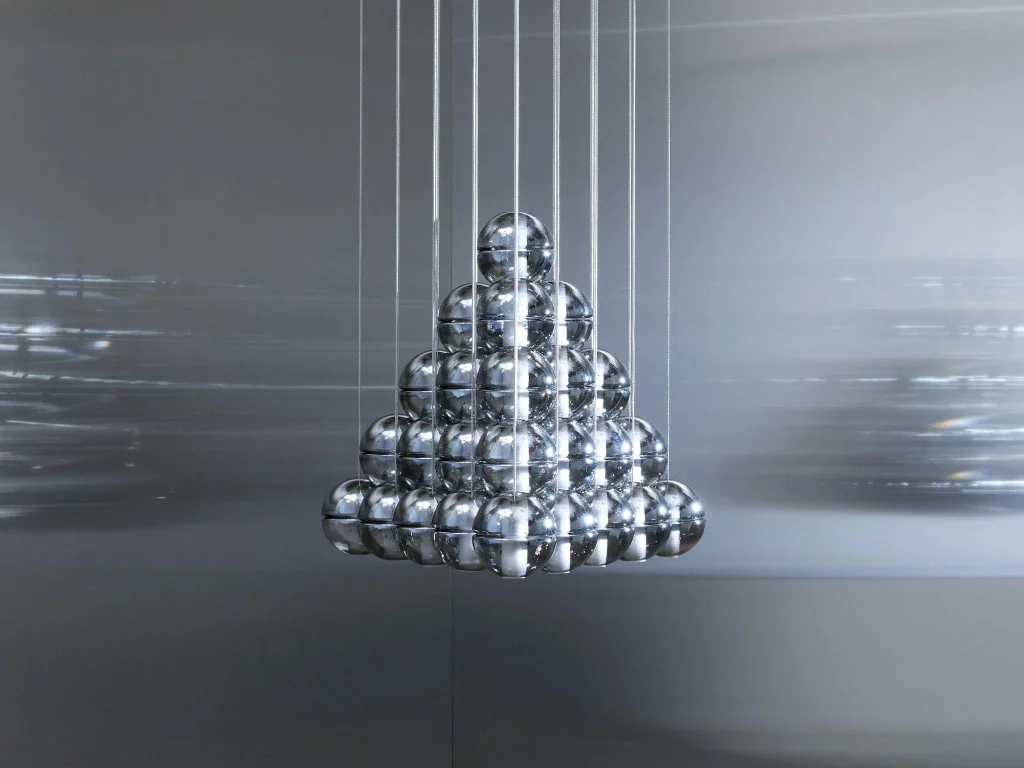
14 Mirror applies a hand-made mirrored surface to Bocci’s first design. Lit, the glass reads as a transparent sphere; switched off, it reflects the room. On sale from 20 October
Bocci has added a mirrored finish to its 14 series, the design the company launched with in 2005. The new version, 14 Mirror, goes on sale at bocci.com from 20 October, across the 14p, the 14 pendant and the 14s.
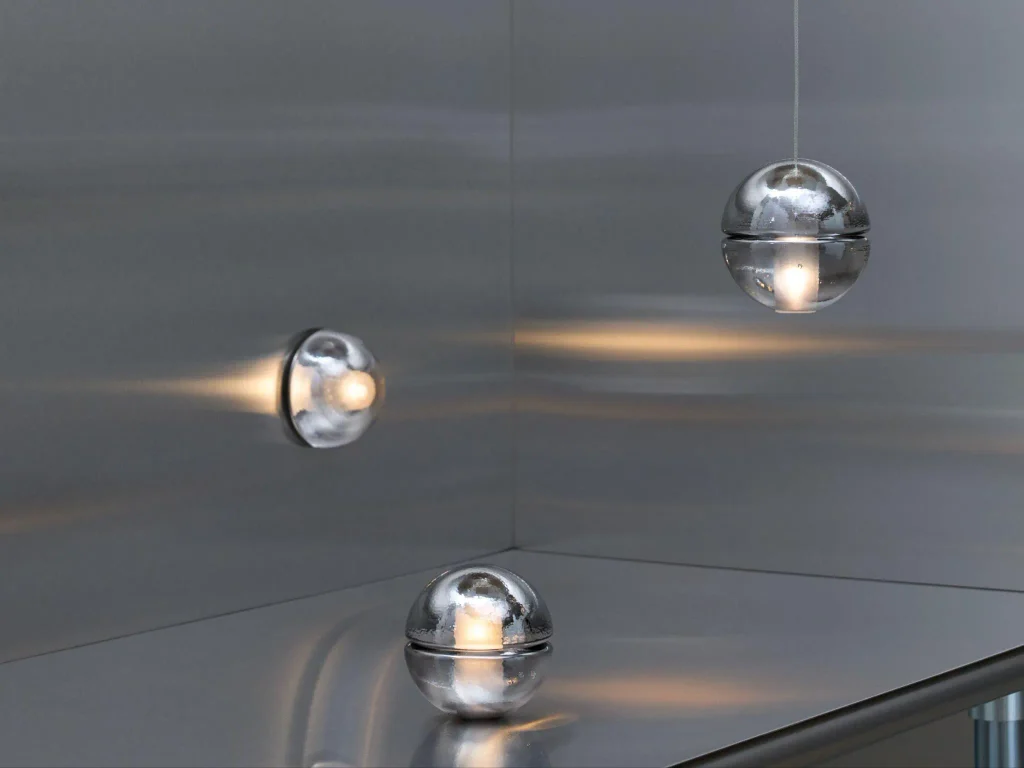
The finish is applied by hand, which leaves variations in opacity from piece to piece. The result is an object with two states: illuminated, the glass works as a transparent orb with the light source inside it; dimmed or switched off, the surface turns reflective and takes in the room around it.
Bocci 14 by Omer Arbel: what it is and how it is made
The 14 was designed by Omer Arbel and introduced with the company in 2005. It is a solid sphere, not a shade. Two hemispheres of cast borosilicate glass are brought together, leaving a rough equator where a meniscus forms as the glass cools — an accident the company kept and made part of the design. A passage is then diamond-drilled through the sphere to take the fitting, and each piece is finished by hand, so no two are identical.
Retail specifications give a 4-inch diameter, a frosted cylindrical void housing either a 10W xenon lamp or a 1W LED, and suspension on a braided metal cable. The 14 took a Red Dot and a Good Design Award from the Chicago Athenaeum in 2007.
That construction is what the new surface works against. With the light inside the mass of the glass, a reflective outer layer does not darken the object: it returns light from the outside while the source stays within, which is why the piece changes character when the switch is thrown.
14 Mirror: how a mirrored finish on glass is made
A mirror on glass is a layer of metal. Two routes are in common use: chemical silvering, in which a silver salt is reduced onto the surface from solution and can be laid on by hand, and vacuum deposition, in which aluminium is evaporated onto the glass in a chamber. The first gives an uneven film, the second a uniform one.
A finish described as hand-applied, with deliberate variation in opacity, belongs to the first family. Bocci has not specified which chemistry it uses, or whether the layer sits on the inner or outer face of the glass.
Orbital: Bocci’s 14 Mirror at Paris Art & Design Week
The collection is shown during Paris Art & Design Week in an exhibition titled Orbital, with scenography by Cameranesi Pompili. The studio was founded in 2013 by Valentina Cameranesi Sgroi, creative director, and the set designer Enrico Pompili, and works between Italy and France on installations, sets, photography and research projects, including the carpets Frammenti and Tatami for MDF Italia.
The stated subject is perspective, doubling, symmetry and optical illusion — the operations a mirrored object performs on a room without help. A reflective sphere returns a compressed image of everything around it, including the other spheres in the room, so a group of them multiplies instead of repeating.
Bocci: from Vancouver to a Berlin courthouse
Bocci was founded in 2005 in Vancouver by Arbel, who is creative director, and Randy Bishop, who runs the company. The catalogue is numbered chronologically by project, not by product type, which is why the lighting families run 14, 16, 21, 28, 38, 57 and 73.
In 2015 the company took a 10-year lease on a six-storey former courthouse in the Charlottenburg district of Berlin, which opened on 6 November that year as its first production site outside Canada, with glassblowing and ceramics studios and a showroom spread over more than 40 rooms.
The 14p, the portable rechargeable version of the sphere, was introduced in 2023. 14 Mirror is available in the 14p, 14 pendant and 14s from 20 October at bocci.com.