Organised by Collezione Ramo, the sixth edition runs 10 exhibitions pairing contemporary artists with twentieth-century masters, alongside workshops and a debate on authorship in the age of AI
Ten exhibitions open across Milan from 21 to 29 November, in commercial galleries, an architect’s studio, the Cittadella degli Archivi, a flower shop and a writing school, with an opening night on 20 November and free admission throughout. Curated by Irina Zucca Alessandrelli, the sixth edition sets living artists against sheets drawn from Collezione Ramo’s holdings of twentieth-century Italian drawing.
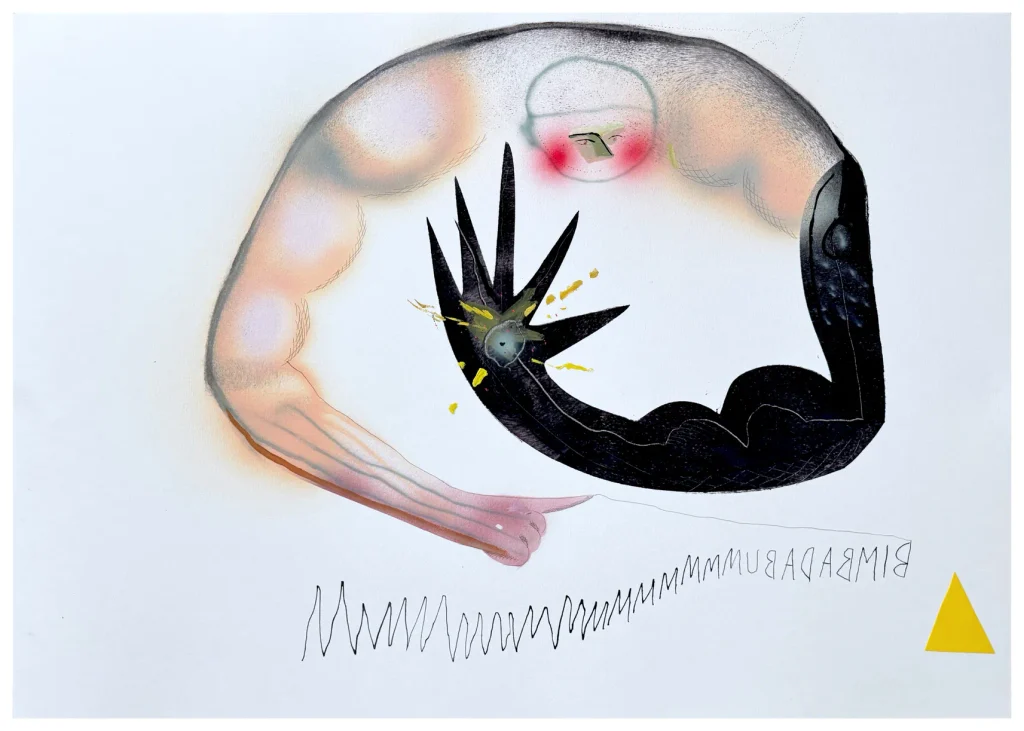
BIMBADABUMMM, 2026
China, olio, tempera e pellicola adesiva su carta, 42 x 59,4 cm
Courtesy the Artista
Milano Drawing Week 2026, drawing as an independent artistic language
A drawing can precede a painting, set the structure of a sculpture or record an idea before it takes a final form. For many artists, though, the sheet of paper is the finished work itself, where lines, erasures and interruptions reveal a process other media conceal. From this reading Milano Drawing Week builds its programme: conceived with the City of Milan’s Department of Culture, it spreads 10 exhibitions through galleries, museums, archives and unconventional spaces — among them a flower shop, a magazine store, a writing school and the Pinacoteca Ambrosiana — rather than gathering them in one institution. Each show follows a single principle: a contemporary artist chooses works by a twentieth-century Italian master from Collezione Ramo and builds an exhibition in dialogue with them. The edition gathers 8 such encounters, with two institutional shows dedicated to Emilio Scanavino and Ericailcane.
Collezione Ramo and the history of Italian drawing in the twentieth century
Collezione Ramo holds about 800 works on paper from the twentieth and twenty-first centuries, by artists who shaped Italian modernism, postwar abstraction, conceptual art and contemporary experimentation. It reads drawing in an expanded sense — pencil and ink beside watercolour, pastel and collage — as a field for investigating form, space, language and perception. Sensitive to light and humidity, the sheets are kept horizontally in conservation folders under regulated conditions, so showing a selection opens to the public a collection that usually stays protected. Earlier exhibitions include Chi ha paura del disegno? at the Museo del Novecento in 2018, Who’s Afraid of Drawing? at the Estorick Collection in London in 2019 and Silent Revolutions: Italian Drawings of the 20th Century at the Menil Drawing Institute in Houston in 2020, with the research also gathered in Disegno Italiano del XX secolo, edited by Irina Zucca Alessandrelli for Silvana Editoriale in 2018.
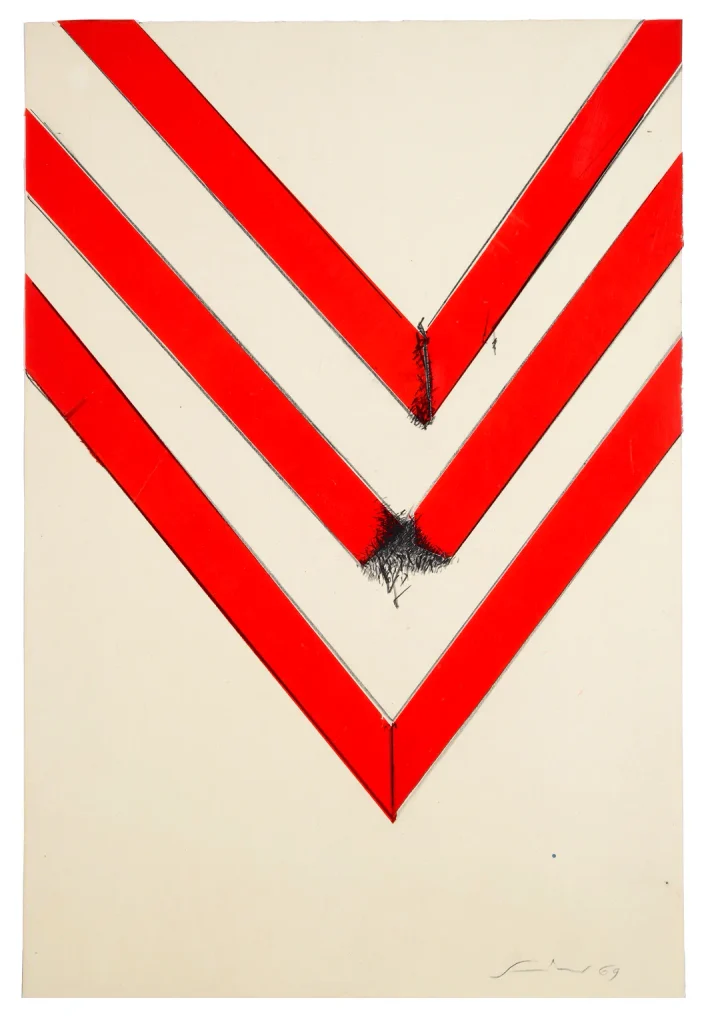
Senza titolo, 1969
Matita grassa e acetato su cartoncino, 51.9 x 35 cm
Courtesy Collezione Ramo
Emilio Scanavino and Ericailcane, two exhibitions on the possibilities of drawing
At the Fondazione Scanavino, Datemi un punto fermo, curated by Irina Zucca Alessandrelli, covers twenty years of drawings by Emilio Scanavino, including previously unseen erotic works. Born in Genoa in 1922, Scanavino built a language of lines, knots, grids and repeated marks across drawing, painting and sculpture, working on the relationship between a gesture and the structures its repetition produces; the show follows that evolution on paper. It opens on 23 November in Piazza Aspromonte.
At the Cittadella degli Archivi, Cercami tra i cani is given to Ericailcane, an artist tied to Italian street art whose drawings turn on anthropomorphic animals. Drawing on illustration and fable, the work places familiar creatures in scenes of authority, submission and conflict, so figures from children’s stories carry social and political observation. Set in an archive, the work also raises the relation between drawing and the walls his images usually occupy. The opening is on 20 November, from 6.30pm to 10pm, with music and a tote bag made by the artist.
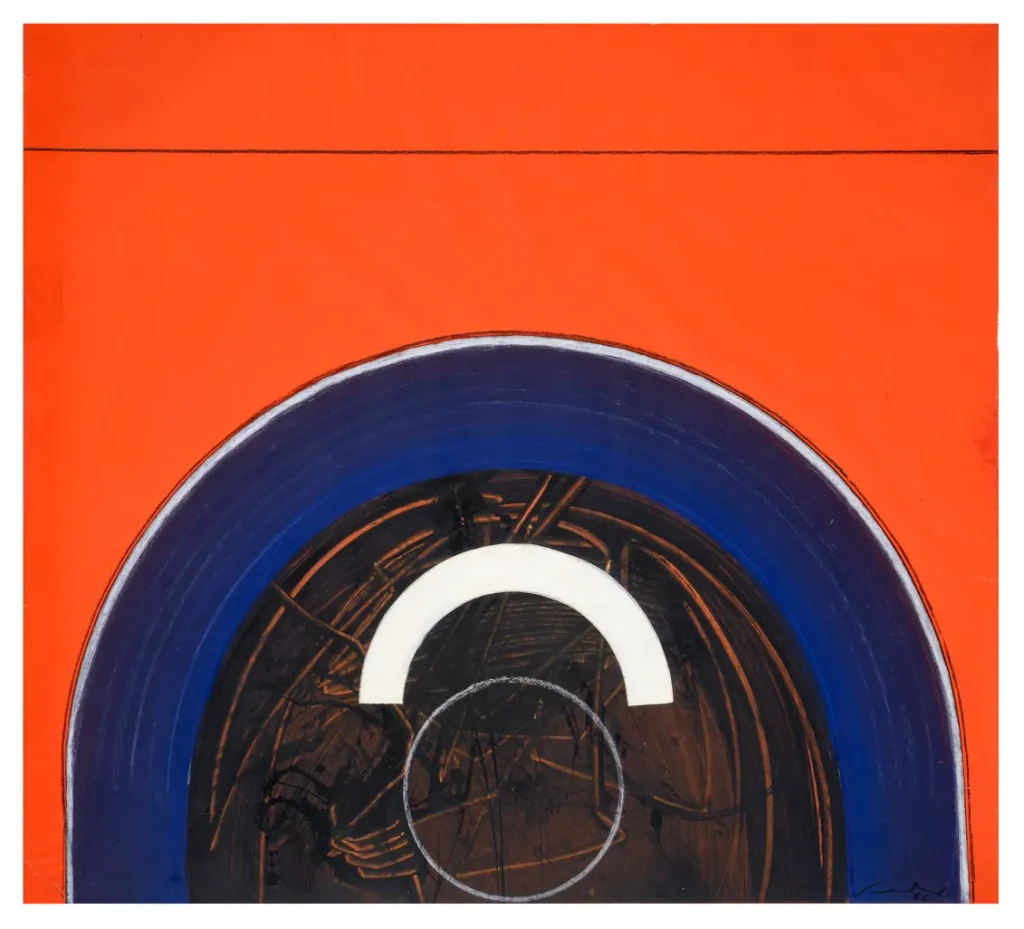
Senza titolo, 1966
Tempera, acrilico, pastello a cera, matita grassa e collage su carta preparata, 67.2 x 74.5 cm
Courtesy Collezione Ramo
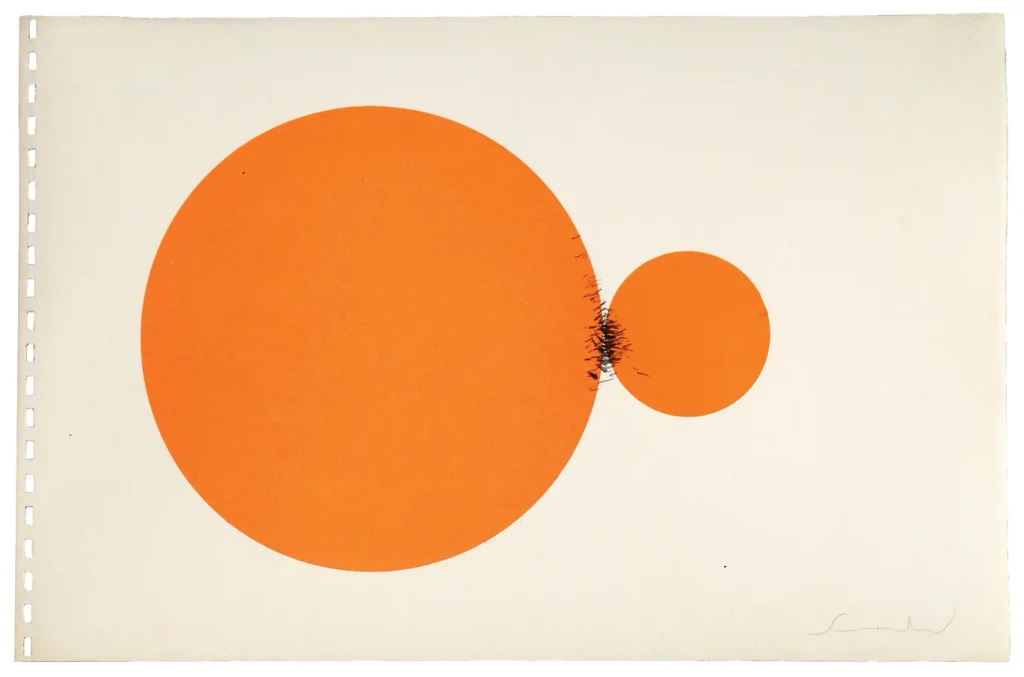
Senza titolo, 1968
Collage e matita colorata su carta stampata, 23.7 x 36.4 cm
Courtesy Collezione Ramo
Lucio Fontana, Alighiero Boetti and Bruno Munari in dialogue with contemporary artists
The 8 exhibitions chosen by Irina Zucca Alessandrelli connect artists whose methods and historical contexts stand far apart. At Francesca Minini, Roberto de Pinto works with Bruno Munari, who kept questioning the lines between art, design, graphic experimentation and visual education. At Tiziana Di Caro, hosted by Osart Gallery, Damir Očko is paired with Lucio Fontana, two generations pressing on the body, space and the limits of representation. Alighiero Boetti appears twice — Hernán Pitto Bellocchio responds to him at ArtNoble Gallery, hosted by Studio Lombard, and Nicole Colombo at Triangolo, within the Marco Piva Art & Design Gallery — one legacy read through different eyes. At RizzutoGallery, hosted by Park Associati, Mattia Barbieri engages Mario Schifano, who reshaped Italian visual culture in the 1960s. Elsewhere Francesco Snote is paired with Antonio Donghi at MATTA, Margarita Gluzberg with Fausto Melotti at Alma Pearl, and Massinissa Selmani with Lucio Del Pezzo at Umberto Di Marino, hosted by Gallerie Guzzetti. The format asks no one to imitate: the historical sheet is a starting point, from which affinities and contrasts emerge.
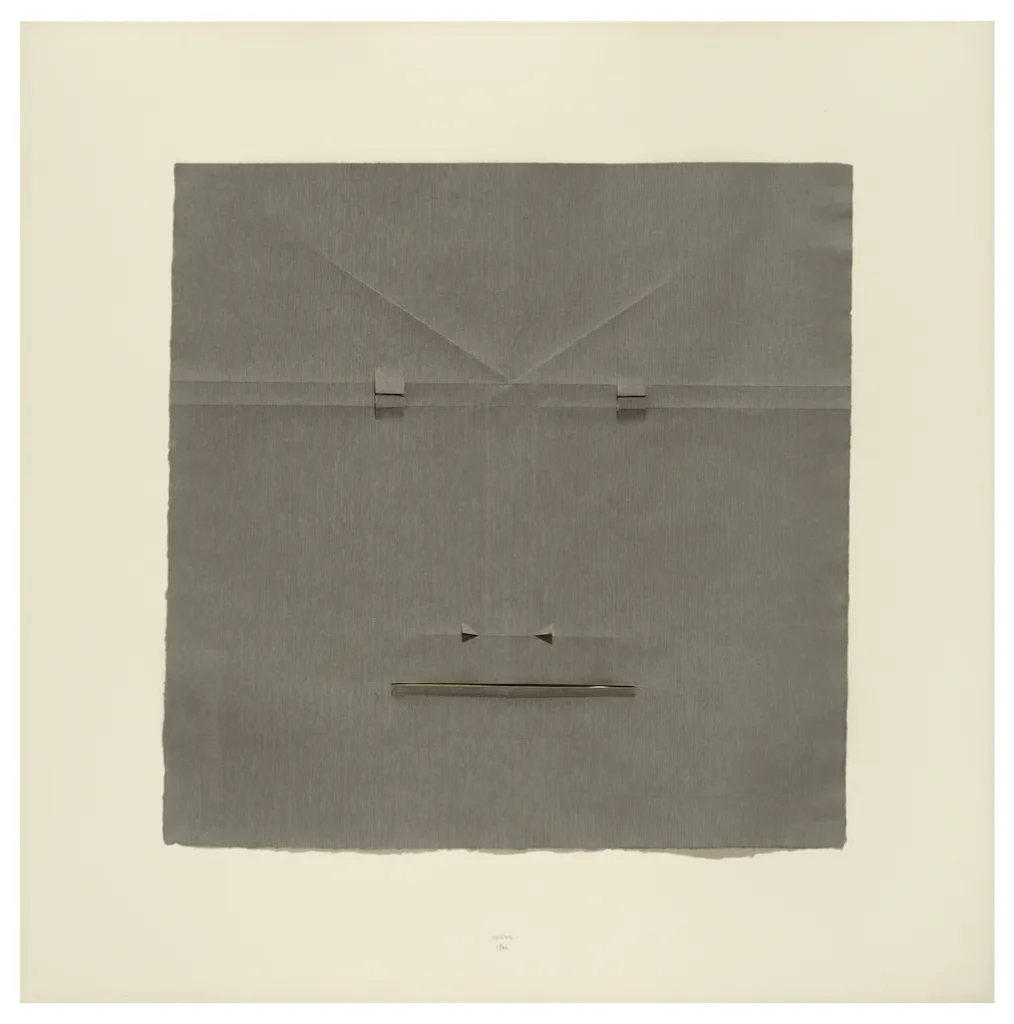
Senza titolo, 1966
Carta piegata applicata su cartoncino, 70.3 x 70.3 cm
Courtesy Collezione Ramo
Beyond the exhibition, drawing enters Milan’s flower shops, bookstores and public spaces
At OFFFI, a flower shop on Via Carmagnola, the artist Gabriella Ciancimino stages a card-reading performance from drawings based on wild plants growing in abandoned parks and residual urban spaces across Milan, where botany, numerology and drawing meet (25 to 27 November). At Frab’s Magazines, the Paris magazine The Drawer is presented on 26 November with Barbara Soyer, Sophie Toulouse and Marco Di Giovanni. At UFO Milano, on 24 November, the Scuola di Santa Rosa, founded by the artists Francesco Lauretta and Luigi Presicce, brings its collective drawing practice to the space over an evening aperitivo, and a similar spirit runs through the Sketch Meeting by Urban Sketchers Milano at the church-museum of San Fedele on 22 November, where 100 participants draw the collection at once. Workshops round out the programme: Angelica Gerosa leads Ritagli d’artista, a collage session for children aged 4 to 12, at PIANO Bi on 22 November, and on 29 November Alessandro Bonaccorsi presents Disegno brutto at the Belleville writing school, for adults who believe they cannot draw.
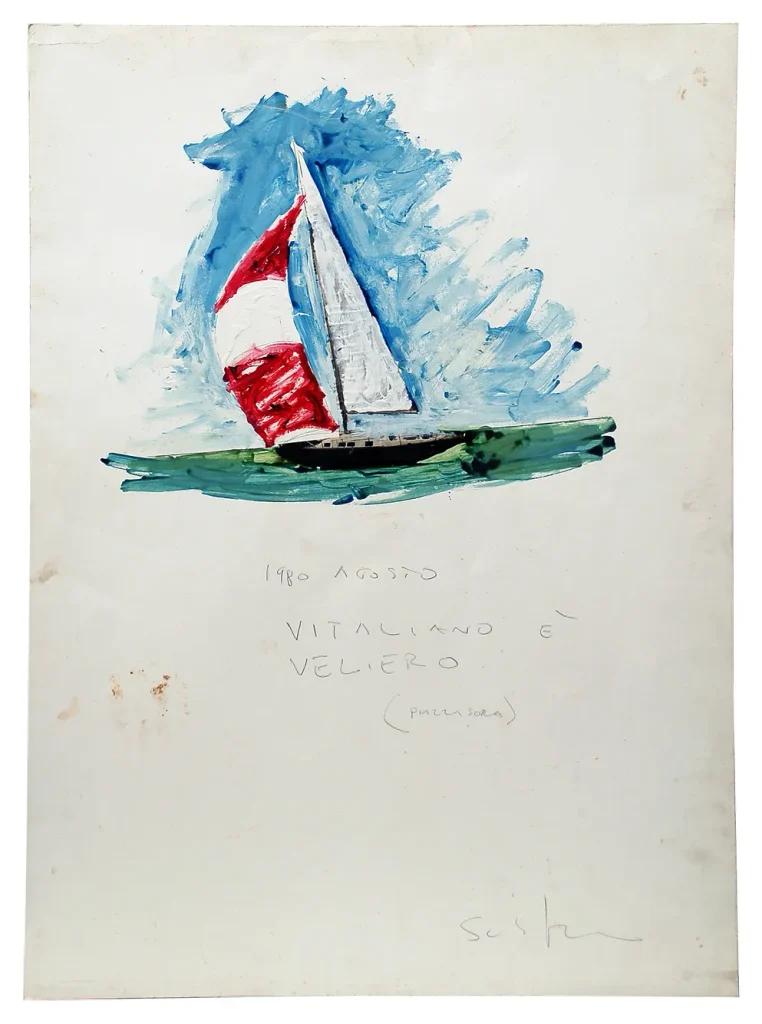
Vitaliano è veliero (Piazza Sora), 1980
Smalto, collage e matita grafite su carta, 95.7 x 69.7 cm
Courtesy Collezione Ramo
Can an artistic style be protected in the age of generative AI?
On 28 November the Pinacoteca Ambrosiana hosts È ancora possibile tutelare lo stile? — Is It Still Possible to Protect Style? — a conversation between the artist Roberto Cuoghi and the lawyer Elisa Vittone, moderated by Irina Zucca Alessandrelli. Unlike a single work, a style is hard to isolate as an object of legal protection: it shows in recurring formal choices, materials or methods, none of which belong to one author alone. Generative AI sharpens the problem, since systems that produce images in recognisable visual languages blur the lines between influence, imitation and reproduction — a question that cuts close to drawing, often read as the most direct trace of an individual gesture.
The Milano Drawing Week Prize and a residency in London
The edition carries the Premio Milano Drawing Week, supported by Gruppo Censeo and given to one of the participating contemporary artists. For 2026 it takes the form of a one-month residency in London at Worlding Project, founded by Joana Neves and Diogo Pimentão, to support research and widen connections within the international network of drawing.
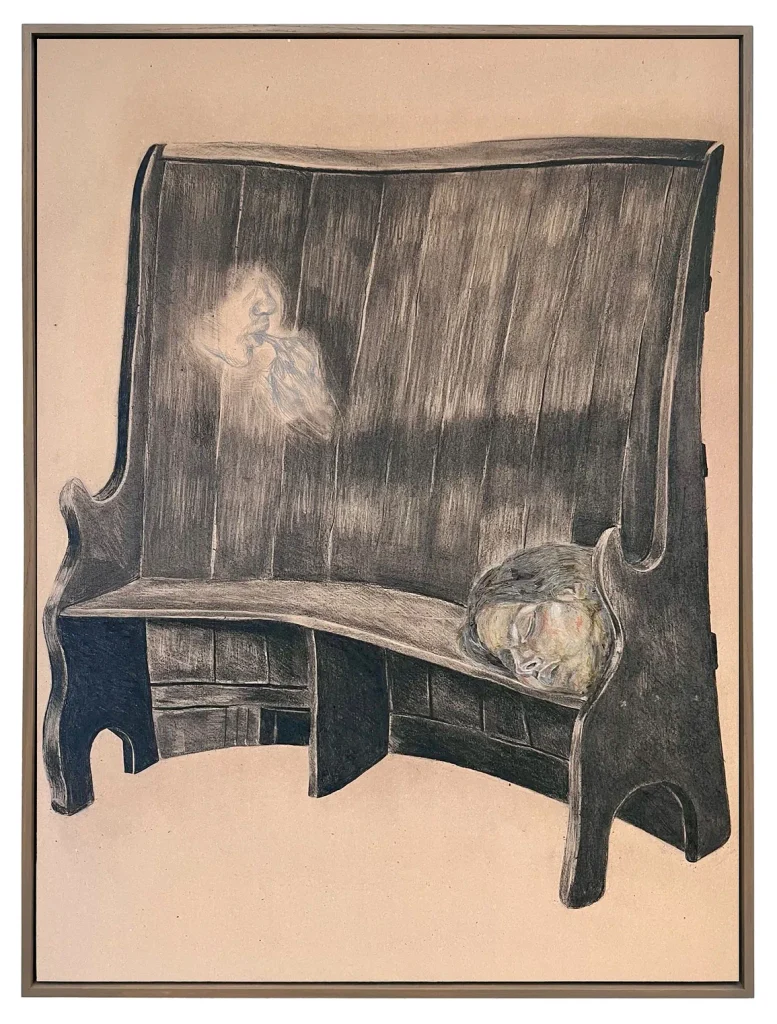
Fontanella, 2026
Carboncino, grafite e encausto su cartone organico, 71 x 101 cm
Courtesy the Artist
Milano Drawing Week 2026, dates, exhibitions and visitor information
Milano Drawing Week runs from 21 to 29 November 2026, opening on 20 November at the Cittadella degli Archivi, Via Ferdinando Gregorovius 7. The 10 exhibitions involve Fondazione Scanavino, Cittadella degli Archivi, Alma Pearl, ArtNoble Gallery, Francesca Minini, MATTA, RizzutoGallery, Tiziana Di Caro, Triangolo and Umberto Di Marino, with presentations in further exhibition and architectural spaces. Admission is free; some workshops require paid registration or have limited capacity. The full programme is at milanodrawingweek.com.
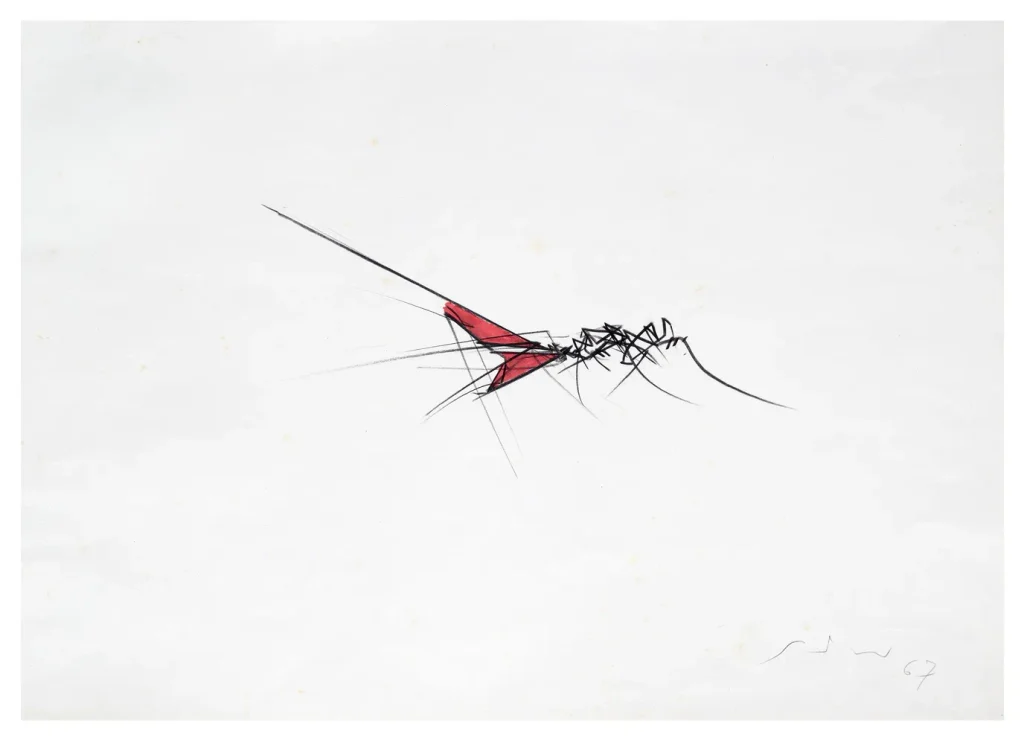
Senza titolo, 1967
Matita colorata e pennarello su carta, 32.9 x 46 cm
Courtesy Collezione Ramo