Chahan Minassian translates Buccellati’s silver craftsmanship into interior design, while the Fall Collection explores the Maison’s traditional manufacturing techniques
At Via Montenapoleone 23, overlooking the courtyard of Palazzo Gavazzi, Buccellati has opened a space dedicated to hospitality. The Caviar Bar is the second collaboration between the Milanese jewellery and silverware house and Paris-based designer Chahan Minassian, after the renovation of the building’s Piano Nobile in 2024.
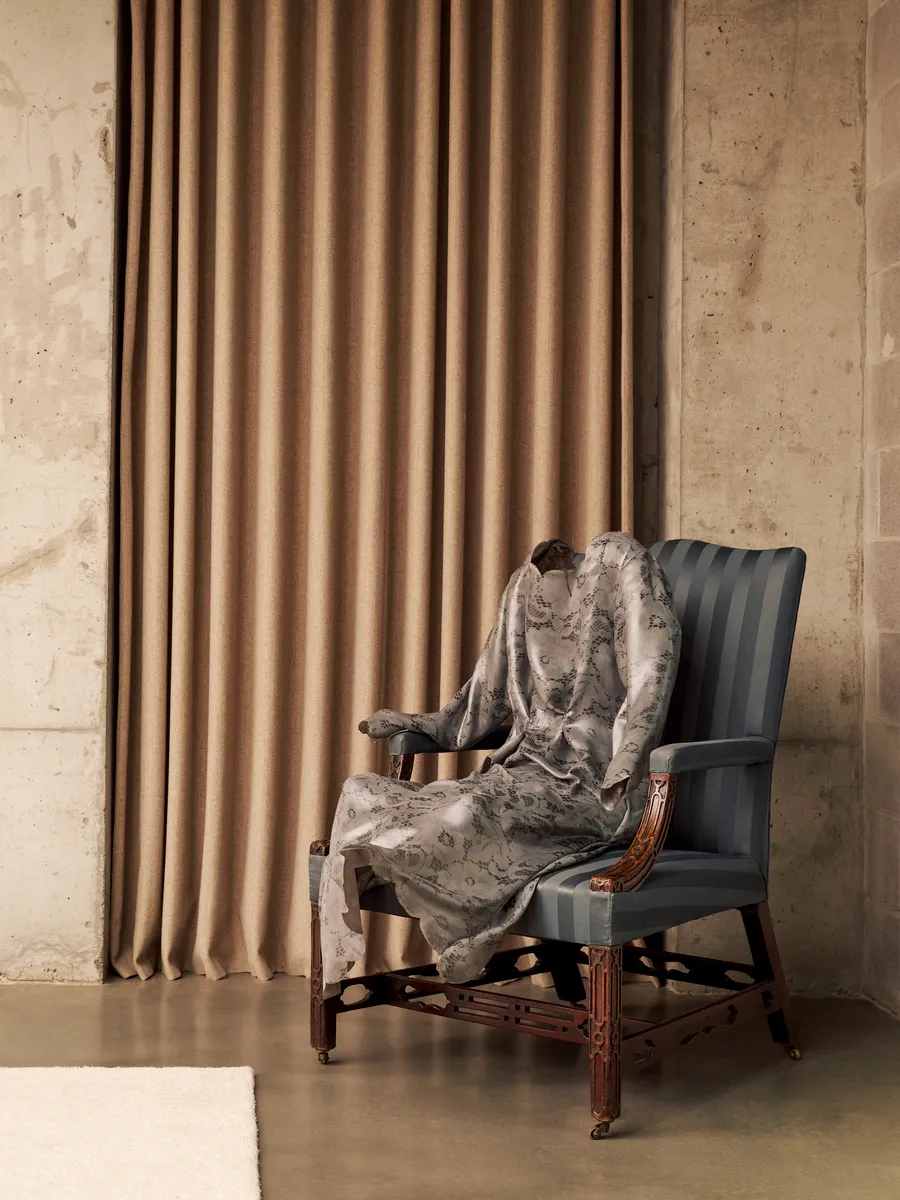
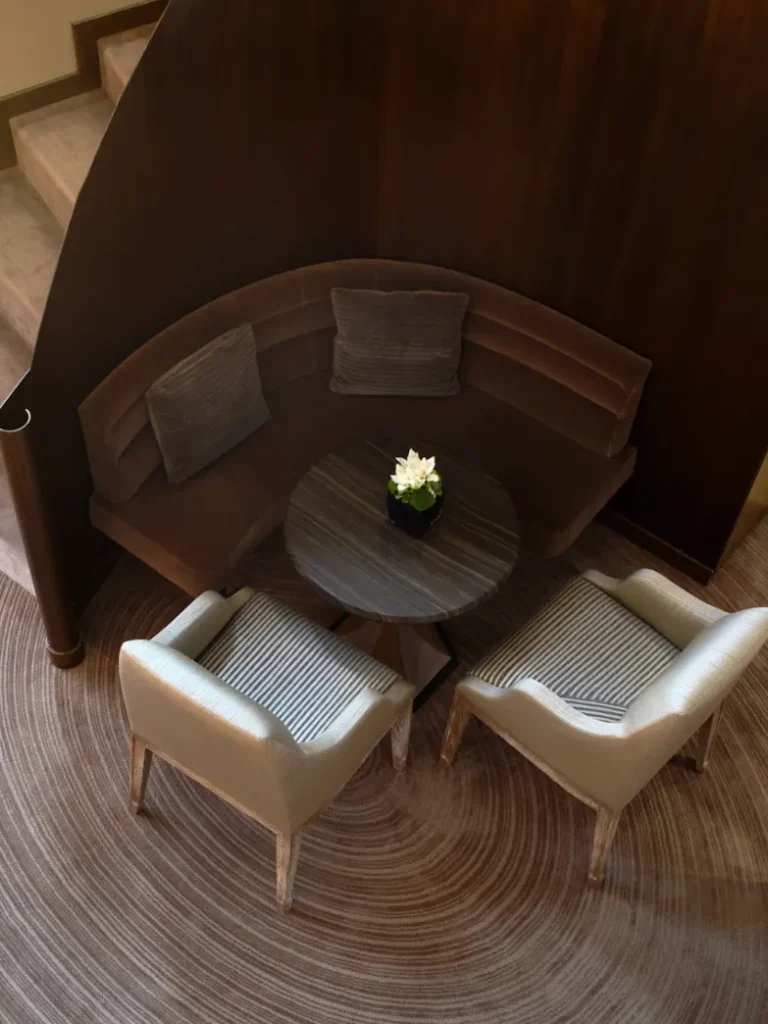
The interior occupies two levels, with a glass mezzanine over the main salon. A central bar, lounge seating and bistro tables split the room into areas for conversation and smaller gatherings. Mirrored panels cover the vaulted ceiling and spread the light. Velvet upholstery, Fortuny fabrics, textured carpets and custom furniture bring in different surfaces; historic Murano glass chandeliers sit alongside contemporary pieces.
Minassian’s work for Buccellati began with the Piano Nobile, carried out with Milan’s Studio Quadrilatero. The rooms occupy the first floor of the nineteenth-century building, designed between 1838 and 1839 by architect Luigi Chierichetti. The renovation kept the existing frescoes, mosaic floors and architectural details, and added contemporary furniture and display cabinets made for the Maison.
In both projects the materials link the building to the collections. For the Piano Nobile, Minassian used metallic tones, textured fabrics and iridescent silks drawn from the surfaces of the Maison’s jewellery, with textiles by Bevilacqua, Fortuny and Rubelli.
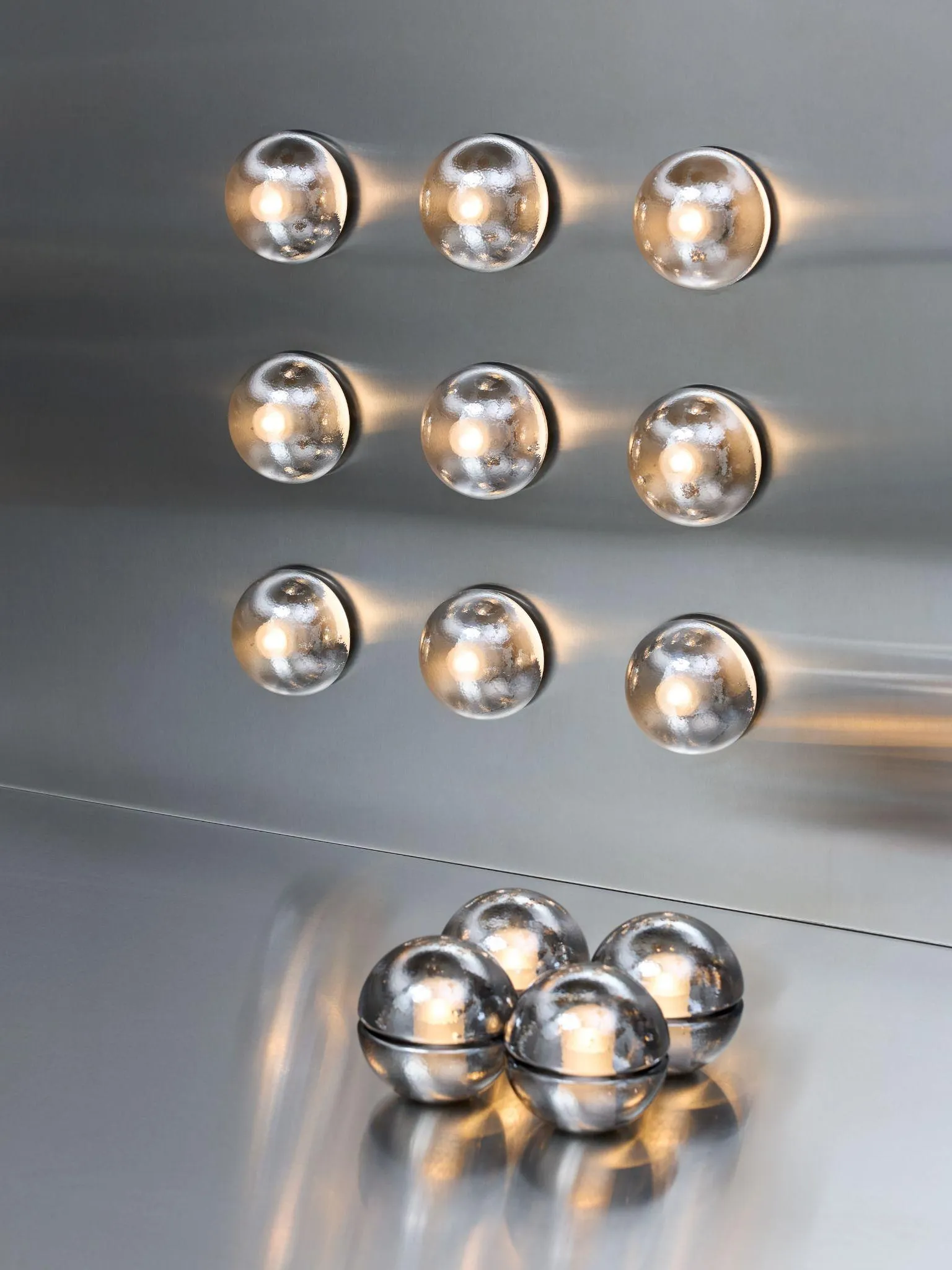
The Caviar Bar develops the same approach through a different layout. Its reference is the silver surface of the Caviar collection, a field of small repeated spheres. The motif stays implicit: the project works through reflective surfaces, metallic tones and contrasting textures, and organises the room around light, material and the objects on show.
The history of Buccellati’s Caviar collection: from the 1930s to Gianmaria Buccellati’s Cratere delle Muse
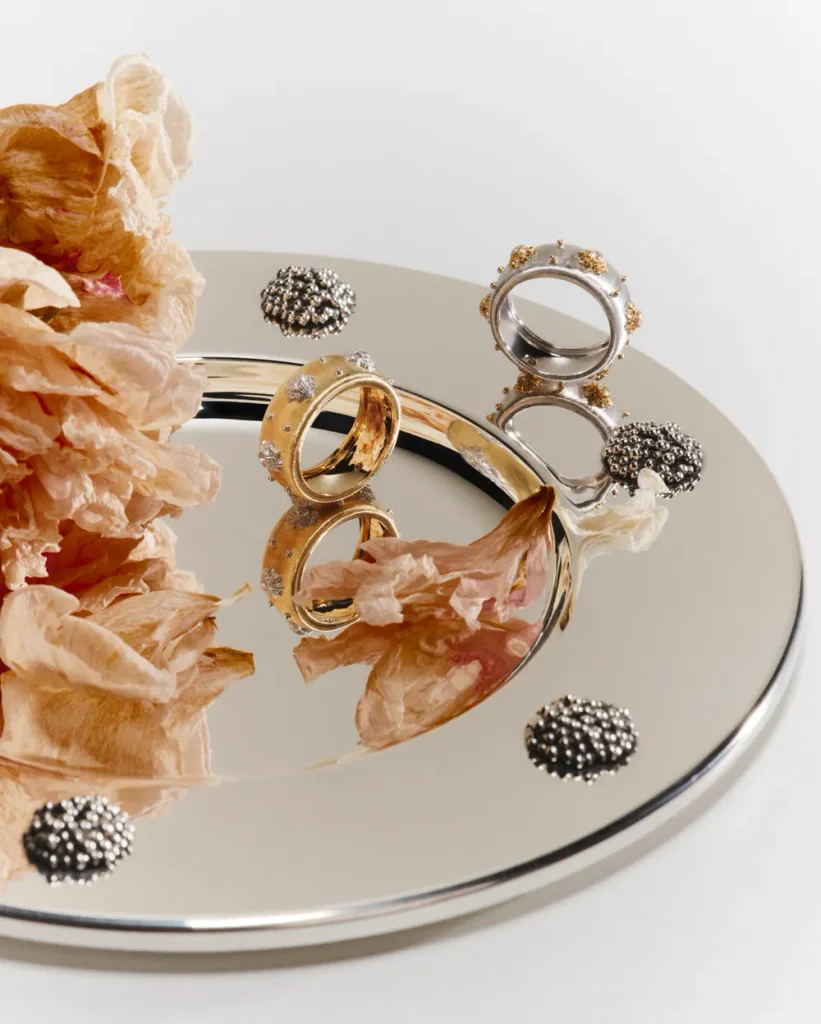
The Caviar collection takes its name from a decorative technique that covers a surface with a dense constellation of silver microspheres. The spherical motif is a long-standing feature of Buccellati jewellery and silverware; Andrea Buccellati reinterpreted it for this collection, working, as with every piece, from an original drawing. Artisans then build a fine “crown” of silver microspheres that gives the motif its shape and changes how the metal reflects light.
The technique finds one of its clearest expressions in the Cratere delle Muse (1981), one of Gianmaria Buccellati’s works, part of the Oggetti Preziosi collection conceived to measure up to the masters of the goldsmithing tradition. The cup is worked in silver, gold, jade and sapphires and belongs to the Fondazione Gianmaria Buccellati.
The collection covers caviar spoons, trays, plates, ice buckets, Murano glassware and flutes. The latest additions are a complete flatware set, two caviar bowls in different sizes and a bread plate, shown during Milan Design Week in April 2026. Each element is worked by hand with traditional silversmithing.
Buccellati’s Furry technique: how silver is worked to reproduce animal fur and feathers
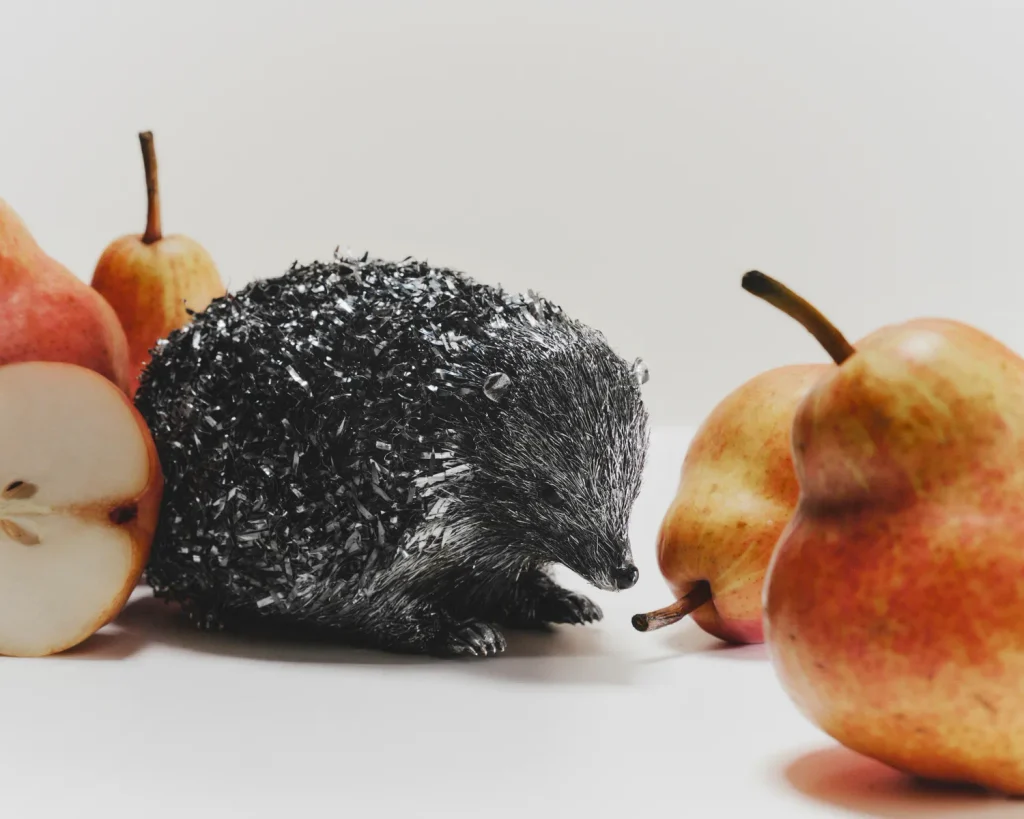
The Fall Edit also brings new decorative bowls from the Furry collection, which uses silver to reproduce animal fur and bird feathers. Gianmaria Buccellati devised the method in the 1960s, looking for a way to render fur and feathers with more realistic detail than existing techniques allowed.
The collection began with large animals — deer, eagles, flamingos. As the technique advanced, Buccellati moved to smaller creatures, squirrels and sparrows, and over more than sixty years to dogs, koalas, monkeys and oryxes, and to birds built with a dedicated feathering technique.
The process starts from very thin silver sheets, frayed by hand and applied to a plaster mould to hold the texture. The care instructions follow from the method: instead of the usual silver cleaning, a Furry piece is brushed lightly with brass bristles.
The two techniques work the same material in opposite directions. In Caviar, repeated spheres make a regular pattern. In Furry, irregular silver filaments reproduce an organic surface.
The technique has also reached museums. In 2006 the American collector Betty Grisham donated a twenty-piece collection to the Huntsville Museum of Art in Alabama, to which Gianmaria Buccellati added a pair of roe deer; the group formed the core of the permanent exhibition A Silver Menagerie. The Furry animals have since appeared at the 2023 Venice Art Biennale, in Buccellati, The Prince of Goldsmiths, and at Nomad St. Moritz, alongside the Cervino collection.
Buccellati’s Murano and Nature collections: botanical forms in silver and hand-blown glass
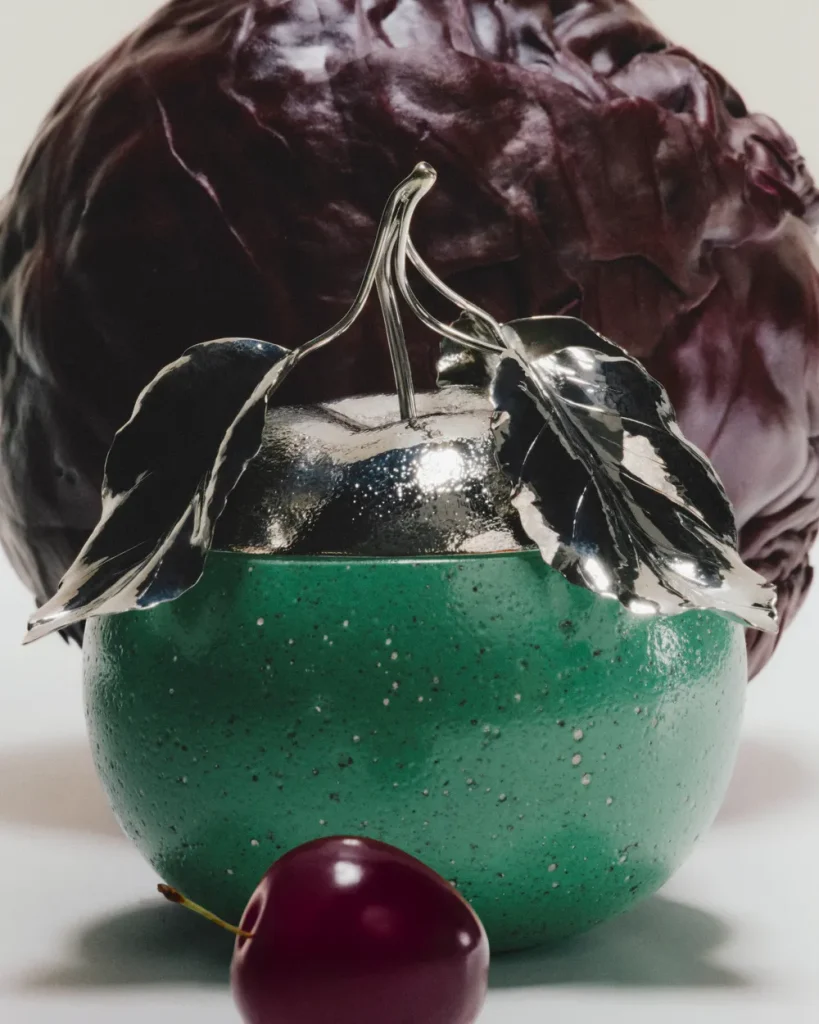
Natural forms also start the Murano and Nature collections, both in the Fall Edit, worked in different materials. Within the Murano line, the Jam Jar series pairs a hand-blown Venetian glass base with a silver lid shaped as foliage or fruit. The jars are made for jams, preserves and sauces, and the range now runs to lemons, oranges, plums, apples, peppers, pumpkins, pears, mushrooms, pineapples, hazelnuts, peaches, tomatoes and raspberries, with a blackberry as the latest addition. A set of miniature place-card holders, tiny fruits and vegetables, completes the table.
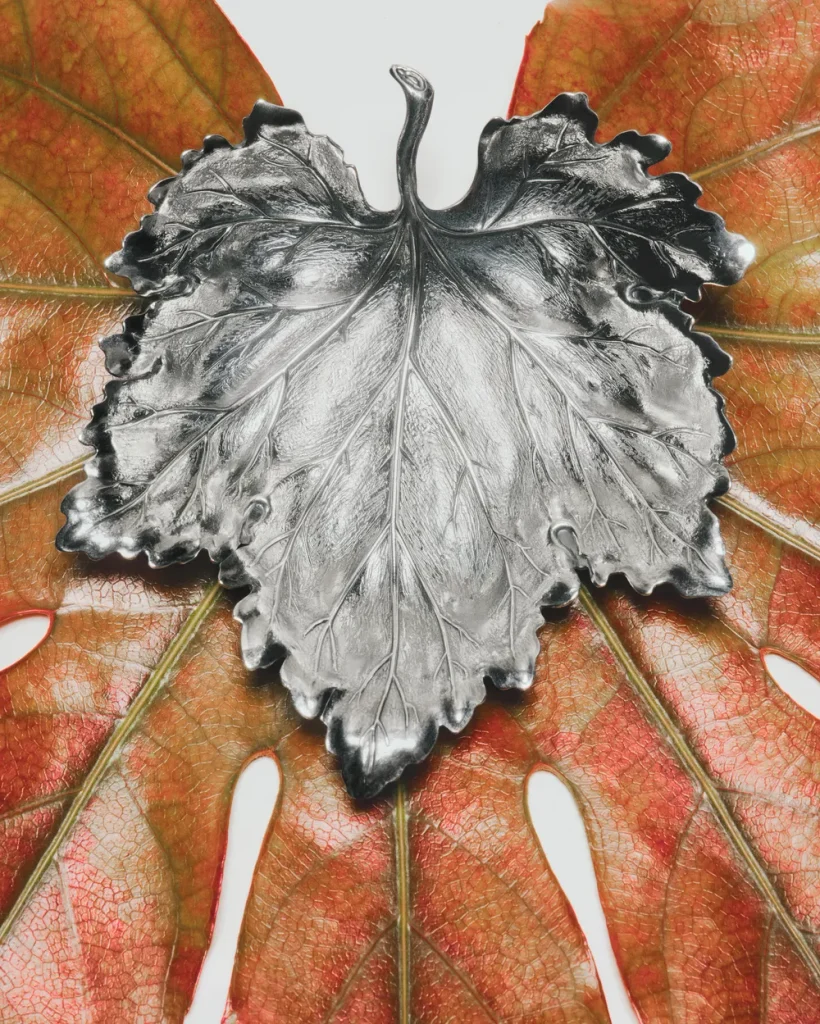
The Nature collection works the same botanical vocabulary entirely in metal, along a line that runs from Mario Buccellati — who turned leaves into bracelets — through Gianmaria to Andrea. Silver bowls reproduce flowers and leaves, multiplied into triptychs; place-card holders, silver frames and candelabra with vine leaves extend the same language to the whole table.
The larger pieces are the centrepieces. Armatae Flores, a garland of hand-worked artichokes on a silicified wooden base, was shown at Homo Faber in Venice in September 2024; a centrepiece of poppies rising from a floral base that doubles as a container was presented at TEFAF Maastricht in 2025.
These objects take on the physical shape of their subjects: leaves become bowls, flowers become small containers, botanical arrangements the structure for larger centrepieces.